Bill McKibben on Democracy Now April 15, 2010
Posted by Jill S. Schneiderman in climate change, fossil fuel.add a comment
Amy Goodman, host of Democracy Now, interviewed Bill McKibben today. Bill makes his points well.
Household Garbage to Energy April 13, 2010
Posted by Jill S. Schneiderman in earth community, fossil fuel, incinerators, landfills, municipal waste (household garbage), recycling.add a comment

Today’s New York Times article (“Europe Finds Cleaner Energy from Trash) explains how incinerators that burn household garbage, ones that are much cleaner than conventional incinerators, are being used to turn local trash into heat and electricity for neighborhood homes in Denmark. Multiple filters on these incinerators trap toxic pollutants such as mercury and dioxin. Over the last ten years, these plants have become the main means of garbage disposal and an important source of fuel in areas of varied land use and economic class. Use of these incinerators has minimized the country’s need for fossil fuels for energy and has reduced the use of landfills, thus diminishing the country’s carbon emissions. In Denmark, garbage is a clean alternative to fuel, not a disposal problem.
It’s a remarkable story and one that seems a good tribute by which to acknowledge today’s release of Bill McKibben’s new book, Eaarth: Making a Living on a Tough New Planet. Bill McKibben, author of more than a dozen books including The End of Nature (1989), perhaps the first book for the layperson about climate change, and founder of 350.org, a global warming awareness campaign that coordinated what CNN called “the most widespread day of political action in the planet’s history,” has devoted much energy to rallying awareness about climate change.
In Eaarth, McKibben argues that humans have changed Earth in such fundamental ways that it is no longer the planet on which human civilization developed over the past 10,000 years. Seawater is becoming acidic as oceans absorb carbon from the atmosphere; the cryosphere—Earth’s once frozen realms of ice caps and high mountain glaciers—has melted or is in the process of doing so; tropical regions of the globe have pushed two degrees further north and south changing patterns of rainfall and causing droughts, fires and floods. It’s a new planet he says, hence Eaarth, not Earth and we’ve got to wake up and start living on it differently.
What to do? Steer away from the path of insatiable growth that has caused Earth to morph into Eaarth, says McKibben. “Scale back” and “hunker down.” Create communities that concentrate on the essentials of maintenance rather than the spoils of growth. He provides inspirational examples of neighborhood windmills, provincial currencies, corner markets, and local internet communities to jump-start this endeavor.
Let’s add to his list of changed behaviors, the use of Danish garbage incinerators. Today’s New York Times article notes that no new waste-to-energy plants are planned for the United States, even though the federal government and twenty-four states currently classify waste that is burned this way for energy as a renewable fuel. We have 87 trash-burning power plants in the U.S., almost all built at least 15 years ago. Right now, we send most of our garbage to landfills. New York City sends 10,500 tons of residential garbage to Ohio and South Caroline every day. Why? The worst trend in traditional environmentalism is responsible for this situation. Not-In-My-Back-Yard-ism.
As McKibben urges in Eaarth, it’s time for a change folks. In Denmark, garbage to energy plants are placed deliberately in the communities they serve so that the heat of burning garbage can be most efficiently sent to homes. In the community highlighted in the NYT article, Horsholm, 80% of the heat and 20% of the electricity comes from burning trash. As a result, homeowners’ bills as well as carbon dioxide emissions are lower.
It’s this type of thought and action that Mckibben urges us towards in Eaarth, an inspiring read.
Ruptured coal ship + Leaking heavy fuel oil = Devastated reef April 5, 2010
Posted by Jill S. Schneiderman in coal, coral reefs, fossil fuel, Great Barrier Reef, oil, oil spill.3 comments

(Image from Australian Maritime Safety Authority / April 4, 2010)
In attempting to address the question of how humans should behave as actors in the system of environmental change, I’ve been thinking and writing about writer Rob Nixon’s concept, slow violence. To use Nixon’s words, slow violence is an oxymoron because acts of slow violence are those with lethal repercussions that sprawl across space and time. (For more on the concept read Nixon’s remarkable paper “Slow Violence, Gender and the Environmentalism of the Poor” in Journal of Commonwealth and Postcolonial Studies, 2007)
Nixon has said that it’s hard to get people to recognize slow violence because the effects are so much greater than the space and time of one human life time. He says we need graphic images that can serve as icons to motivate us to stop perpetrating such acts.
So, my vote for an icon of slow violence is the sad image above that was printed in the Los Angeles Times today. It shows the more than 700-foot long, Shen Neng 1 , carrying 65,000 tons of coal striking the Great Barrier Reef (note that coral reefs cover less than 1% of the world’s oceans) and leaking heavy fuel oil from the 300,000 gallons it carries to run its engines.
Hydraulic Fracturing for Natural Gas April 4, 2010
Posted by Jill S. Schneiderman in fossil fuel, hydraulic fracturing.1 comment so far
 Despite the fact that we humans must curb our use of fossil fuels, the technique of hydraulic fracturing (aka ‘fracking’) is being touted as an innovative way to extract natural gas from shale deposits. In my home state of New York, much attention has been paid to the issue because of the presence of an extensive sedimentary layer, the Marcellus shale, that could serve as a substantial source of the fossil fuel. For a balanced treatment of the potential promise and peril of this technology see the Scientific American report, “Fracking to Free Natural Gas”
Adventures with Wind on Water March 20, 2010
Posted by Jill S. Schneiderman in Barbados, book review, Buddhist concepts, earth cycles, geology, learning differences.2 comments
This piece is cross-posted at Shambhala SunSpace.
Earth Dharma: “Planned Outage”
 Yesterday I stepped onto the volcanic terra firma of St. Vincent, though I hesitate to call it that given the spate of earthquakes in the first quarter of 2010, after having sailed down the Grenadine islands with my partner, our two kids, and their grandparents. Chris, the skipper of our Barefoot Charter, was a forty-something nice guy who had recently checked out of Washington (state), left behind television, telephone, and internet connection, to follow his dream of skippering sailboats in the Caribbean Sea. When I saw that the name of our fifty-foot monohull was Planned Outage and glimpsed Chris reading The Art of Happiness by H.H. The Dalai Lama, I felt delighted about the experience we were about to have.
The book I’d taken with me on the three-day sail was Saltwater Buddha, Jaimal Yogis’ memoir about learning the lessons of Zen Buddhism while living a surfer’s life. I have to admit that after reading a brief excerpt I didn’t see immediately the appeal of the book. I thought to myself, “What is this guy going to teach me about lessons learned along a meandering course of thrill seeking?” I’d done my own share of thrill seeking and meditating and I’ve lived a lot longer than Yogis, encountering my own piece of disillusionment. But as Charles Darwin surely thought about James Hutton’s Theory of the Earth, his choice of reading material aboard the Beagle, “this book is great!”
I didn’t know Yogis’ tale and had no idea he ended up at the Columbia School of Journalism but I wasn’t surprised to find that out because Saltwater Buddha is a good story. From California to Hawaii to France, India, Brooklyn and finally back again, with richly described characters like a sagacious Hawaiian insurance agent immobilized by Elephant Man disease, leather-skinned commercial fishermen in dock-side bars in Montauk, red rubber-suited Santa Cruz “Surf Nazis”, and a hilarious caricature of Yogis as a bliss-seeking surf bum who gets closest to having a real job when as a barista in San Francisco he gets “really good at making the thick foam with the little leafy designs,” Yogis shows his readers how lessons of dharma abound in life experiences that range from the mundane—caring for a sick friend—to the absurd—surfing in a snowstorm in Brooklyn.
I was attracted to the book because I’m living seaside, having run away from professional responsibility with my family at the age of 50, so that we all could recover from the two-year ordeal of dealing with schools, psychologists, doctors and lawyers while negotiating the rough surf that’s called education for kids with learning differences in the U.S. Not to mention the exposure of our difference as a family with queer parents. I’ve been seeking the healing balm of the sea spray myself—an escape from the samsara caused by narrow conceptions of intelligence—meditating daily and interspersing my days and those of my kids with windsurfing and sailing. My whole family has taken to living in the present, and the blue waters surrounding this chunk of coral in the eastern Caribbean have certainly helped. As my friends say, it’s been a skillful move.
What I loved about Saltwater Buddha is the way Yogis easily accesses earth dharma. His observations about wind and water resonated for me as a geoscientist who alternates periods of sitting and adventures with wind on water. For example, Yogis describes the earth science related to surfing: creation of tides as the moon tugs at the ocean; materialization of waves as water feels the seafloor on its coastal approach; and, formation of wind owing to temperature differences between land and sea. Yogis sees the poetry of the earth system.
Of the four spheres of the earth system—rock sphere, biosphere, atmosphere and hydrosphere—the latter two, as fluids, are especially available to sentient beings as dharma teachers because they move and change in time frames quick enough for us to perceive them. Living this year at the edge of the sea, I walk daily along the shore and watch the fluctuating character of the air and water. When previously I’d been for short periods to places where I’d hoped for placid seas, it always seemed that my timing was off—according to the locals the sea was calmer or the wind more gentle just before I’d arrived. But living at the waters edge this year, I see that the ocean—the biggest reservoir of the hydrosphere— and the atmosphere change constantly. They manifest fluidity.
In Saltwater Buddha, Yogis quotes Suzuki Roshi: “waves are the practice of water. To speak of waves apart from water or water apart from waves, is delusion.” My shore walks reveal that we can say the same for the atmosphere; wind is the habit of air and to speak of the two apart from one another is fantasy. The ways of water and air bring home the Buddha’s fundamental teaching of impermanence. As Yogis recognized, each different face of the sea offers episodes of samsara and nirvana. Lately Caribbean breezes have taught me lessons that Brooklyn surf taught Yogis.
Huge swells and shifting winds have caused me to be caught up “in irons” on my dinghy and capsized in a mooring field; but I’ve also had the chance to ride winds on a beam reach while hawksbill turtles lift their heads for subaerial breaths above teal blue waters. As the surfer merges with his medium, so the sailor melds with hers. Connecting with our surroundings in these ways fosters the natural inclination to live with harmony on Earth.
Too, both pastimes are good metaphors for life. Since environmental conditions are mutable, attachment to any one set of circumstances causes suffering. Yogis’ book in combination with my Caribbean sailing adventures reminds me of a slogan on the door of the West End Racing Club in Provincetown, Massachusetts: “You can’t direct the wind but you can adjust the sails.” Or, as my dyslexic sailing instructor cautions, “you can only sail where the wind will let you.”
Read-aloud sessions are my family’s book habit. These past three days aboard Planned Outage we listened to sections of Saltwater Buddha. As sharp-eared dyslexics, my kids recognized a good story. They said they’d like to see the movie and were delighted to learn that the visual version is in production. No doubt we’ll all relish seeing the film when it’s released, but for the time being, we’re living Yogis’ lessons together in the present.
For more “Earth Dharma” from Jill S. Schneiderman, click here.
See also:
- Saltwater Buddha: the film
- An exclusive excerpt from Saltwater Buddha
- Losing Everything Can Mean Finally Beginning
- So Sad, No Problem: Roaming India after a painful breakup, Jaimal Yogis befriends a monk who teaches him an unexpected lesson about happiness.
- What’s happened to Sonam? Jaimal Yogis follows up on his spiritual friend.
This entry was created by Jill S. Schneiderman, posted on March 19, 2010 at 8:58 pm and tagged Books, Environment, Science, Zen. Bookmark the permalink. Follow any comments here with the RSS feed for this post.
Growth of Mountaintop Mine, West Virginia, 1984-2009 March 15, 2010
Posted by Jill S. Schneiderman in coal mining.add a comment
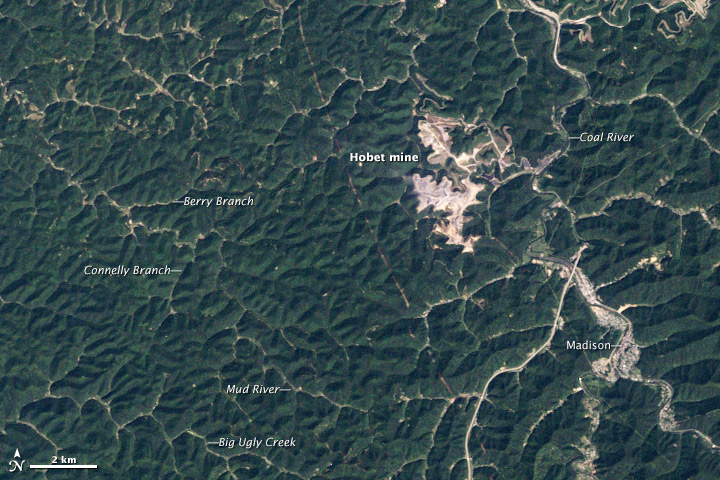
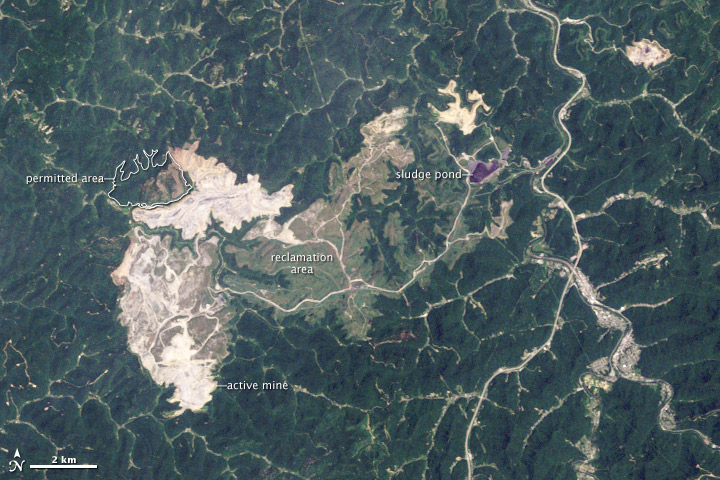
If a picture is worth a thousand words, what’s the worth of these two pictures?
The change in this landscape near Coal River, West Virginia (the meandering line towards the right quarter of each image) is due to the expansion of surface mining operations over 25 years. Why have the mining operations so scarred the land? Is it just that we humans don’t like to clean up after ourselves? If that were so, perhaps we’d have a solution to the problem (for the land if not for the atmosphere). But the fact is, extract solid resources from the earth, crush them, remove what we want and leave the rest (the gangue material), and we have increased the surface area to volume ratio of the original solid. Hence, the gangue can’t fit back in the hole from which we took the mined mineral:

Surface Area of cube with 2 unit length, width, height is: 6 x (2 x 2) = 24
Volume of cube with 2 unit length, width, height is: (2 x 2 x 2) = 8
Surface Area to Volume Ratio is 3:1
Surface Area of 8 1-unit cubes: 8 x 6 x (1 x 1) = 48
Volume of 8 1-unit cubes: 8 x (1 x 1 x 1) = 8
Surface Area to Volume Ratio is 6:1
The point? Surface area increases more quickly that volume. Breaking up a once solid material and trying to fit it back into the same area that it once occupied causes the waste material to expand beyond the hole that originally contained the original resource. As a result, the waste materials must be draped over the surrounding landscape.
For more information on this West Virginia location, visit NASA’s Earth Observatory site that provides further details about these images.
Green, Inc. March 11, 2010
Posted by Jill S. Schneiderman in book review, John Burroughs.add a comment
Democracy Now has a good piece on Green, Inc.: An Environmental Insider Reveals How a Good Cause Has Gone Bad, by Christine MacDonald. 
In short, MacDonald is a journalist who worked for Conservation International (CI), an organization whose stated mission, paraphrased, is to build on a foundation of science, partnership and field demonstration in order to empower societies to care responsibly and sustainably for nature for the well-being of humanity. Though founded in the late 1980s, I hadn’t heard of this environmental nonprofit; from information on its website, it seems to strive towards a people-focused environmentalism.
In her interview with Amy Goodman however, MacDonald charges that CI and other major environmental groups, essentially operate satellite public relations offices for polluting corporations. I’m not surprised by the claim. Robert Gottlieb, years ago pointed out in his book Forcing the Spring: The Transformation of the American Environmental Movement, that there was an “Iron Triangle” between government agencies, corporations, and congressional leaders that sets the framework for policy based largely on economic interests. It sounds to me like MacDonald in Green, Inc. might offer some 21st century proof of Gottlieb’s contention.
What MacDonald had to say reminded me of the fact that President Teddy Roosevelt took nature writer and bird enthusiast John Burroughs on a camping trip to Yellowstone in 1903 in order to soften TR’s image as a large-mammal slayer. Burroughs seems to have allowed his persona to be used by Roosevelt, as well as by industrial titans E.H. Harriman, Henry Ford, Harvey Firestone, and Thomas Edison on other excursions into Nature. Perhaps Burroughs justified being coopted in the same way that environmental organizations today soft-pedal their ‘collaboration’ with corporations, as being for the greater good.
In any case, I want to read this book.
Chile, Haiti, and “Govinda’s Bridge” March 4, 2010
Posted by Jill S. Schneiderman in Andes, Buddhist concepts, Chile, disasters, earth community, earth cycles, earthquakes, environmental justice, geology, Haiti.3 comments
This piece is cross-posted at Shambhala SunSpace.

When I turned as part of my daily practice to today’s page of Offerings, a compilation of Buddhist quotations, I read a comment by Lama Anagarika Govinda that registered as particularly meaningful in light of the recent earthquake in Chile:
“A bridge is revealed which connects the everyday world of sense perceptions to the realm of timeless knowledge.”
Oddly enough, given the topic of collapsed infrastructure as a result of recent high magnitude earthquakes in Haiti and Chile, a visible viaduct has emerged which connects the agonizing reality of these events to the timeless truth that economically and educationally impoverished people are disproportionately vulnerable to risks posed by life on a dynamic planet.
How is it that these two seismic events in the first quarter of 2010 have together exposed Govinda’s bridge?
In order to answer that question we must compare geologically these natural events. Both earthquakes occurred at lithospheric plate boundaries. Geologists have come to expect earthquakes at these locations because such boundaries, which are delineated by earthquakes and often volcanism, are the relatively flexible seams that connect pieces of comparatively inflexible crust comprising the skin of the earth. When rigid crust moves, it releases energy stored in the rocks causing them to break abruptly. This is a fundamental geological reality that all human beings must understand, as a starting point, if we are to lessen the catastrophic human consequences that follow from such natural events. Both temblors were massive — Chile magnitude 8.8 , Haiti 7.0. In fact, the Chilean event ranks among the largest quakes ever measured.
A substantial geological difference between the Chile and Haiti tremors was that the former originated deep in the Earth’s crust, 35 km, while the latter one had a shallow focus, 13 km. The difference in the depth of the rupture relates to the type of plate boundary at each site — sideways sliding in Haiti versus downward thrust in Chile. And though to the geologically uninitiated the difference between 8.8 and 7.0 may seem negligible, the Richter scale is logarithmic, not linear, and that means that the Chilean quake was substantially stronger than the Haitian one. These geological details beg the human question, why do the numbers of Haitian deaths and catastrophic injuries eclipse Chilean ones?
The answer to the question has socioeconomic, rather than geologic roots. An adage well known to geologists reads, “Earthquakes don’t kill people, buildings do.” Many Chileans were spared crush-injuries and death because Chile constructed quake-resistant buildings after experiencing a 9.5 magnitude earthquake in 1960. In this recent event, buildings shook but did not collapse into stacks of flattened concrete, minimizing the chance that Chileans might be killed or trapped inside them. Too, the Chilean quake struck near Concepcion, a region of much lower population than Port-au-Prince.
We can build earthquake-resistant structures with adequate know-how and financial resources. Concrete, a common and relatively strong masonry material consists of cement — primarily heated limestone that is finely ground and mixed with the mineral gypsum—that binds together sand and gravel. But concrete doesn’t stretch or extend very well when stressed by shearing horizontal forces. It can be reinforced with steel bars or pre-stressed for use as an earthquake-resistant building material. Other elements of an earthquake resistant building include a good-quality foundation and high quality cement.
Living on land prone to shift, Chileans endure constant reminders of the need to utilize high quality building materials and enforce strict building regulations. Haitians also receive portentous jolts. But Chile, not Haiti, is one of the most earthquake-ready countries in South America, Central America and the Caribbean. Why are buildings in Chile more stable than those in Haiti? While 98% of Chileans are literate and 18% of the population lives in poverty, the respective numbers for Haiti are 53% and 80%. These numbers may explain why Haitians have used brittle steel without ribbing and poor quality cement to hold together concrete. And using cement too sparingly for mortar between concrete blocks or in the production of the concrete itself reduces the earthquake resistance of the structure built with it. In Haiti inferior building materials and poor building practices have been replicated from the foundation up. As a result, the Haitian earthquake left more than 200,000 people dead, nearly one million people homeless, and an indeterminate amount of pain and anguish; in Chile we may hope that the death toll will not reach four digits.
When we examine a geologic map of the world, an unfortunate reality becomes clear: the earth’s most populous cities exist along plate boundaries. Plate boundaries coincide with shorelines and sources of water hence our earliest civilizations arose there and grew to be villages and towns. Today large population centers in places like Tehran and Istanbul are disasters waiting to happen. Though geologists cannot predict when an earthquake will occur, we can forecast, in decades-wide windows, the inevitability of such events. Haphazardly constructed communities in vulnerable mega-cities put millions of people at risk for the suffering that ensues after a large earthquake in a poorly prepared region. The Buddha taught that suffering is endless yet one must vow to end it. Anyone who subscribes to this principle must reject as unacceptable the disproportionate vulnerability of the poor and under-educated to the earth’s perpetual processes.
President Obama’s Environmentalism February 18, 2010
Posted by Jill S. Schneiderman in environmental justice.2 comments
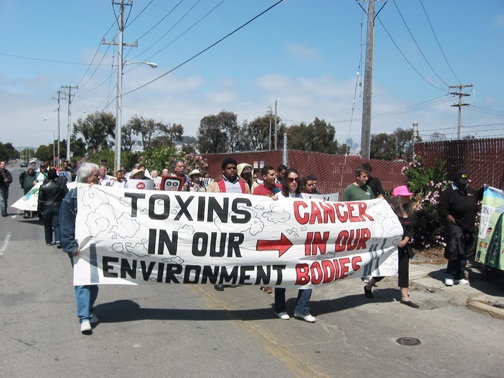
photo by Chris Brizzard, San Francisco Bay View
President Obama has taken plenty of heat lately because he has included nuclear power, offshore oil drilling and “clean coal” as foundations of his energy policy. His recent budget proposes to triple federal construction-loan guarantees for new nuclear reactors at a cost of $54.5 billion. Leaders of organizations including the leaders of the Center for Biological Diversity, Natural Resources Defense Council, and Friends of the Earth, among others, have expressed disappointment in what they view as the President’s limited actions in the arena of energy and environment. But frankly I’m not surprised and I’m not terribly upset by Obama’s choices. We are faced with the seemingly intractable problem of voracious consumption of fossil fuel resources and concomitant global warming. What’s a leader to do?
As Senator Obama, the President supported development of nuclear power and when he became President, he appointed as Secretary of the Interior Ken Salazar, a fifth generation Coloradan who environmentalists felt was too much of a champion for farmers and ranchers. Why am I not so stunned or dejected by President Obama’s choices on these matters? Because his priorities reflect his history as an African American community organizer in Chicago in neighborhoods like the Southside and Altgeld Gardens housing development, areas that have been described as “toxic doughnuts” because of being surrounded by waste facilities and other locally undesirable land uses.
What President Obama may view as among the most pressing environmental issues of the day are issues of environmental injustice—instances in which African American and other people of color communities have become environmental sacrifice zones where polluting industries compromise the health of children and adults who live daily with releases of hazardous substances into proximal air, water and land. For the President, environmentalism may mean prioritizing the rescue of people from contaminated environments rather than protecting environments from people who pollute.
Buddhist Survival in the Andes February 5, 2010
Posted by Jill S. Schneiderman in Andes, book review, Buddhist concepts.add a comment
This piece is cross-posted at Shambhala SunSpace.
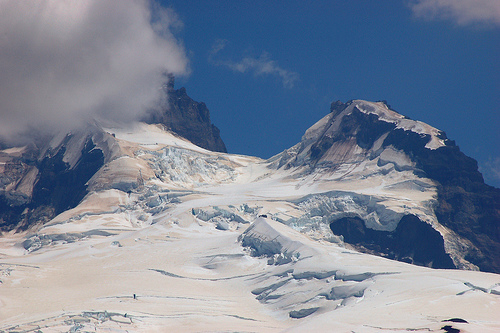
 I just finished reading Nando Parrado’s account of his 72-day ordeal of pain and suffering in the South American cordillera, Miracle in the Andes (2006). It’s an extraordinary testimony of his survival, along with 15 out of 45 people, most of them rugby teammates, after their privately chartered airplane crashes into the side of a volcano en route from Montevideo, Uruguay to San Fernando, Chile and comes to rest on a glacier at nearly 12,000 feet above sea level. Instead of having these members of the Old Christians rugby team play an exhibition game in Chile, the boys—most of them no more than 23 years old—find themselves relying on each other and their most intimate interior selves as they struggle to survive after the Argentine, Uruguayan and Chilean rescue teams have given up the search. Parrado’s observations about the exterior landscape in which he survives impressed me as a geologist. Even more amazing however were his remarks about the interior landscape of survival because to me they resonated with Buddhist thinking about living with suffering.
I’d read Alive (1975), Piers Paul Read’s gruesome and sensational tale of this disaster replete with charges of cannibalism and ostensibly heroic feats, as a high school student in the late seventies; as much as I can remember, it bears little resemblance to the book I just read. In this book, Parrado details the mountainous landscape that hosts the plane’s fuselage including notes about the appearance of glacial ice, volcanic rocks, sedimentary strata, skin-shredding talus slopes, and house-sized boulders reposing in braided streams. Even more noteworthy is his deep appreciation of the Earth’s vast scales of geologic time. Parrado writes: “I felt an involuntary sense of privilege and gratitude, as humans often do when treated to one of nature’s wonders, but it lasted only a moment. After my education on the mountain, I understood that all this beauty was not for me. The Andes had staged this spectacle for millions of years, long before humans even walked the earth, and it would continue to do so after all of us were gone” (203). Parrado has the eye of a naturalist. Benefiting from the gift of time more than 30 years after his hardship he describes with poetic accuracy this remote, inaccessible high-reaching cordillera, a terrain that most people will never encounter.
Parrado’s description of this trek to salvation on his own behalf, as well as that of other survivors, hints at the truly remarkable interior landscape to which his trial allowed access:
On the morning of December 8, the seventh day of our trek, the punishing snow cover began to give way to scattered patches of gray ice and fields of sharp loose rubble. I was weakening rapidly. Each step now required supreme effort, and a total concentration of my will. My mind had narrowed until there was no room in my consciousness for anything but my next stride, the careful placement of a foot, the critical issue of moving forward….
I would feel an apprehension of the age and experience of the mountains, and realize that they had stood here silent and oblivious, as civilizations rose and fell. Against the backdrop of the Andes, it was impossible to ignore the fact that human life was just a tiny blip in time, and I knew that if the mountains had minds, our lives would pass too quickly for them to notice. It struck me, though, that even the mountains were not eternal. If the earth lasts long enough, all these peaks will someday crumble to dust. So what is the significance of a single human life? Why do we struggle? Why do we endure such suffering and pain? What keeps us battling so desperately to live, when we could simply surrender, sink into the silence in the shadows, and know peace? (212-213)
Parrado’s depiction of his interior journey resonates with Buddhist approaches to a life of suffering. Central to Parrado’s ability to survive was his emphasis on breathing. More than once he recounts how his reminder to focus on the breath was the key to his survival. He writes:
I drew a long breath and then slowly, richly, I exhaled. Breathe once more, we used to say on the mountain, to encourage each other in moments of despair. As long as you breathe, you are alive. In those days, each breath was almost an act of defiance… Again and again, I filled my lungs, then let the air out in long, unhurried exhalations, and with each breath I whispered to myself in amazement: I am alive. I am alive. I am alive. (233)
What’s more, Parrado exhorted himself to pay attention for he saw that ability as life-saving. In puzzling over whether his survival was an act of God or of self-reliance he wrote:
It was not a God who would choose to save us or abandon us, or change [us] in any way. It was simply a silence, a wholeness, an awe-inspiring simplicity. It seemed to reach me through my own feelings of love and I have often thought that when we feel what we call love, we are really feeling our connection to this awesome presence. I feel this presence still when my mind quiets and I really pay attention. (263)
Parrado described how, by being present for every step and every breath, he was able to survive each moment of pain, loss, and suffering: “These moments bring time to a stop for me. I savor them and let each one become a miniature eternity, and by living the small moments of my life so fully, I defy the shadow of death that hovers over all of us, I reaffirm my love and gratitude for all the gifts I’ve been given, and I feel myself more and more deeply with life.” (262) Though Parrado gives no indication that he studied Buddhist teachings, he sounds as if before the crash he’d been meditating for years. He tells his readers that something in the mountains wanted him to be still: “I gazed at this place: we had upset an ancient balance, and balance would have to be restored. It was all around me, in the silence, in the cold. Something wanted all that perfect silence back again; something in the mountain wanted us to be still.” (188)
In these trying times that to some may feel as difficult as survival in the high Andes, Parrado offers well-tested advice—breathe, pay attention, be still.
For more “Earth Dharma” from Jill S. Schneiderman, click here.


Trackbacks are closed, but you can post a comment.
 earthdharma.org