
A Taste of Impermanence December 14, 2011
Posted by Jill S. Schneiderman in Buddhist concepts, Buddhist practice, contemplative practice, impermanence.add a comment
This piece is cross-posted at Shambhala SunSpace.
We were a few days into a week-long silent meditation retreat and pecan bars were on the lunchtime dessert menu. I was particularly into the process of bringing mindful awareness to mealtime. In the past, the practice resulted in loosening knots in my mind so I felt open to the possible surprises this retreat might offer.
A sign next to the dessert tray listed the ingredients: brown sugar, butter, eggs, pecans. I decided to indulge and took one pecan bar to my seat at the massive, dark table in the silent dining room of this one-time monastery. It was small, soft, and barely held the rectangular shape into which it had been cut. I placed it in my mouth and felt the sweetness on my tongue.
Served at room temperature, the pecan bar began to melt in my mouth — literally. Since I was practicing mindful eating, I didn’t chew at first. For many moments I held a nutty morsel in my mouth. Over time, my saliva dissolved the sugary brown butter. Sitting in attentive stillness I noticed the changing size and shape of this small mouthful. Over time, my mouth held nothing more than pecan fragments. Slowly I chewed and swallowed them.
A remarkable thing about this experience of mindful eating was that it provided an embodied way to appreciate the phenomenon of weathering — the process by which Himalayan-sized mountains get transformed into Appalachian-sized nubs. It’s not an easy transformation to envision — 24,000 feet-high mountains being reduced an order of magnitude to 2,000 feet in hundreds of millions of years. And yet it is true that impermanence applies to Earth formations as well as to mental ones. Even seemingly permanent landscapes don’t last forever in the fullness of geologic time. How does this happen? Mindful consumption of pecan bars shows the way.
Because pressure and temperature conditions deep inside the Earth differ substantially from those above ground, rocks and minerals experience a change of state from equilibrium — a mineralogical equivalent of equanimity, if you will — to disequilibrium when they become exposed at the surface. Rocks and minerals disintegrate and decompose as they readjust to the changed conditions. Without needing to be transported, they are chemically and mechanically transformed.
Rocks and minerals are not organic, living beings and yet they are impermanent. During the type of chemical weathering known as dissolution, fluids alter the structure of a mineral by adding or removing elements. It is by this process that marble monuments become less defined when subjected to acidic rainwater.

In the case of the melting pecan bars, the moist warmth of the mouth provides both a chemically active fluid and temperature conducive to the breakdown of sugar crystals.

During mechanical weathering, rocks disintegrate physically into smaller fragments, each with no chemical transformation. In the case of those easy-to-swallow pecan bars, teeth did the mechanical work of breaking down the resilient nuts.
Though I often find that earth processes recapitulate the dharma I was delighted to experience in this instance an example of mindfulness practice illuminating earth processes. Impermanence holds true for human beings and mountains but how nice it was to become aware of this benign example during the retreat.
Click here to read more of Jill S. Schneiderman’s “Earth Dharma” posts on Shambhala SunSpace.


Trackbacks are closed, but you can post a comment.
The Keystone XL Pipeline Project: Extremely Unskillful? November 9, 2011
Posted by Jill S. Schneiderman in Buddhist concepts, climate change, Dalai Lama, earthquakes, fossil fuel, fracking, hydraulic fracturing, Jack Kornfield, Keystone XL Pipeline Project, tar sands.add a comment
This piece is cross-posted at Shambhala SunSpace and Truthout
As thousands of people circled the White House to make known their objections to the multibillion dollarKeystone XL Project, I was again reminded of a comment by Jack Kornfield:
“Ours is a society of denial that conditions us to protect ourselves from any direct difficulty and discomfort. We expend enormous energy denying our insecurity, fighting pain, death, and loss, and hiding from the basic truths of the natural world and of our own nature.”
The dedicated activists who gathered to communicate their views to the President and many others are trying to alert the world’s population to a critical basic truth about the Earth: fossil fuels are an exhaustible resource whose extraction is a perilous and foolhardy enterprise. What’s more, they are trying to wake us up to the fact that in our pursuit of energy sources, greed prevents us from acting skillfully.
The Keystone Gulf Coast Expansion (Keystone XL), operated by Calgary-based TransCanada, is the southernmost geographical component of the Keystone Project that will carry crude oil derived from Alberta, Canada tar sands through Saskatchewan, across Montana, South Dakota, Nebraska, Kansas, and Oklahoma to southern Texas where it will be refined along the Gulf of Mexico. In a recent interview TransCanada CEO Russ Girling commented
“We never expected to be the lightning rod for the development of the Canadian oil sands. At the end of the day we build a conduit from A to B.”
What’s wrong with this attitude? The idea that this complex enterprise can be reduced to as simple a notion as connecting two points by a line can only arise from a profoundly confused mind. Here’s some geoscience in the service of clarity.
“Tar sand” is a generic term used to describe petroleum-bearing rocks exposed at the Earth’s surface. Because petroleum is hydrocarbon its combustion for energy contributes significantly to well-established global warming. Geologists know tar sands as natural bitumen which means basically that it is a very viscous (sticky) petroleum. This stickiness distinguishes it from heavy crude oil, another type of petroleum. Tar sand is more like a flowy (if you will) solid whereas crude oil looks more familiarly like a liquid. It’s the stickiness that makes tar sands particularly problematic as technically recoverable resources.
Two different methods are used to produce oil from tar sands – surface mining andin-situ (in place) production. Only about 20 percent of all tar sand resources are recovered via surface mining. The rest is obtained through the later technique of in-situ processing which involves pumping steam underground through a horizontal well to liquefy the bitumen and pump it to the surface. Despite publicity about Canadian oil sands from the American Petroleum Institute intended to inform and assure those with well-founded worry about pipeline leaks and water contamination of western aquifers, such processing may be simple but it’s not easy. We need only look at theDeepwater Horizon fiasco to see how difficult it can be to stop simple flow from a pipe. (And the mind of this New Yorker not only is tempted to go to the past but also to project into the future concerns about hydrofracking in the Marcellus shale for another type of petroleum–natural gas). But let me stay in the present.
The Keystone Gulf Coast Expansion which has attracted so much attention will involve among other components construction of new pipeline in Oklahoma (Keystone Phase III — 435 miles from Oklahoma through Texas). Okay, pay attention. On Saturday November 5, a magnitude 5.6 earthquake was centered six miles southeast of Sparks, Oklahoma. I’ll reframe this geographically: the strongest earthquake ever recorded in Oklahoma struck about 40 miles south of Cushing, Oklahoma which is the point of origin for Keystone XL’s phase III.
The recent earthquake and its continued aftershocks occurred on the Wilzetta fault. It is one of many faults in the area that formed during the Carboniferous Period (around 300 milliion years ago) during an episode of mountain-building activity ultimately leading to the formation of the Rocky Mountains. But we don’t understand the relationship between these recent earthquakes and this old geologic structure. We do know that Oklahoma’s east and west borders are 280 and 750 miles from New Madrid, the namesake of ahigh seismic zone responsible for several of the largest historical earthquakes to strike the continental United States (1811-1812).
H.H. The 14th Dalai Lama has taught that
“a balanced and skillful approach to life, taking care to avoid extremes, becomes a very important factor in conducting one’s everyday existence.”
Our efforts to force sticky hydrocarbons out of the Earth’s sedimentary rocks in Alberta, Canada (A), then transport them thousands of miles across a critical aquifer while skirting a high seismic zone (conduit), so we can refine them in Texas (B) only to burn them to create energy and incidentally warm the planet seems to me extreme, unbalanced, and unskillful.
Share:
What would the Dalai Lama say about fracking? September 16, 2011
Posted by Jill S. Schneiderman in Dalai Lama, fracking, natural gas, science, shale.add a comment
This piece is cross-posted on Shambhala SunSpace.
In his book For the Benefit of All Beings: A Commentary on the Way of the Bodhisattva, His Holiness the Dalai Lama writes, “The actions of each of us, human or nonhuman, have contributed to the world in which we live. We all have a common responsibility for our world and are connected with everything in it.”
That is of course, a statement that applies to people of all kinds; not just Buddhists. As an earth system scientist, I feel the truth of that statement in my bones, every day. So, yesterday when I heard the news that ecologist, bladder cancer survivor, parent and activist Sandra Steingraber had been recognized this year with a Heinz award, I felt a surge of hope. Dr. Steingraber has written numerous books about the perils of a contaminated planet that are simultaneously scientific and personal.
Currently, she is working to prevent the unnatural disaster that will ensue if New York State proceeds with high-volume slick water hydrofracturing of shale gas — fracking — in the state. Steingraber puts it powerfully and renders the earth system science right when she avers, “we are shattering the very bedrock of our nation to get at the petrified bubbles of methane trapped inside.”
Sandra and I have had some supportive communication with one another over the years and so I dashed off a quick e-note of congratulations when I heard about the honor that carries with it a $100,000 unrestricted cash prize. Despite a very busy life, she got back to me quickly to share her statement subtitled “The Heinz Award and What I Plan to Do With It.”
In it, Dr. Steingraber acknowledged the connectedness of earth and all life, writing that “…the bodies of my children are the rearranged molecules of the air, water, and food streaming through them.” She announced her intent to devote her Heinz Award to the fight against hydrofracking in upstate New York where she lives with her family. And she implored others to join her in the struggle to fight fossil fuel addiction. In her opinion, dependency on these nonrenewable resources causes us to act irrationally — removing mountains, felling forests, drilling deeply — and to use these fossil fuels as raw materials for pesticides, solvents, and other toxic substances that insinuate themselves into the tissues of all living beings.
It seems to me that Dr. Steingraber’s thoughts and motives are as much informed by a sense of responsibility — one like the Dalai Lama wrote about – as they are by science. And that, as I say, makes me hopeful.
What about you?
This View of Earth: A Call to Attention September 8, 2011
Posted by Jill S. Schneiderman in Buddhist concepts, Cambridge Insight Meditation Center, disasters, earthquakes, Larry Rosenberg.add a comment
This piece is cross-posted at Shambhala SunSpace

It’s been an eventful couple of weeks here on the eastern edge of the North American continent, despite the fact that we are situated in the middle and therefore relatively stable portion—speaking tectonically—of the North American lithospheric plate.
I felt the 5.8 magnitude Virginia quake on August 23 while sitting in a flimsy camp chair perched on Precambrian bedrock just inches above the ground surface in western Massachusetts. As readers of reports after that quake will know, the old and rigid rocks of the east coast of North America propagate seismic waves very efficiently so this geologic event was felt hundreds of miles away from the epicenter.
Just a few days later, the approach of and preparations for Hurricane Irene truncated the opportunity to marvel at the fact that Earth shook in surprising places. These were two different kinds of earth events: the earlier one a phenomenon of the solid earth possibly rebounding from the melting of Pleistocene ice sheets and the latter, a spectacle produced by the interactions of hydrosphere and atmosphere in the Anthropocene. They had in common the vast spatial scales that are an every day matter for planet Earth. Fortunately casualties among the living were few and we can be grateful for that. Nonetheless this planetary activity serves as a reminder that the earth is alive, and like any living being, deserves compassionate attention.
Aropos of these events, I recently finished a one-day sit with Larry Rosenberg at the Cambridge Insight Meditation Center. Larry’s instructions, very helpful on the cushion, are useful to me now as I reflect on the earth’s dynamism in preparation for my introductory earth science course. Seasoned meditators will relate to Larry’s instructions: to be present rather than to wallow in an unchangeable past or become lost in an uncertain future.
His words have a direct geological analog in the famous saying by James Hutton, considered the founder of geology, the earth shows “no vestige of a beginning,–no prospect of an end.” Hutton penned the words in an attempt to convey to a populace yet unacquainted with radiometric dating what he believed to be the vastly ancient age of Earth. But after sitting with Larry, I also read Hutton’s statement as an invitation to be present in the moment. The Earth’s past is indeed unchangeable and it’s future uncertain. All we can do right now is pay close attention to the communications we receive from this living planet.
This entry was created by Jill S. Schneiderman, posted on September 6, 2011 at 10:10 am and tagged Environment, Science. Bookmark the permalink. Follow any comments here with the RSS feed for this post.
Connected Across a Billion Years August 4, 2011
Posted by Jill S. Schneiderman in Eden Village Camp, environmentalism, geology, Hudson Valley, Jewish spirituality, metamorphism, science.add a comment
This piece is cross-posted at Shambhala SunSpace.
For the past month my family and I lived at Eden Village Camp in Putnam Valley, New York. Rooted in the Jewish vision of creating a more environmentally sustainable, socially just, and spiritually connected world, the campers at Eden Village were empowered to promote a vibrant future for themselves, their communities and the planet. While my partner and I worked as science “specialists”—focusing especially on earth science—and our children participated as campers, we lived a collaborative effort to create an earth-based, safe, and kind community.
As a result, I came to think of Eden Village as a Jewish version of the Buddhist sangha.
My job at the camp was to connect campers scientifically with the ground we walked. In fact, this was a remarkable opportunity not only scientifically, but spiritually because the bedrock of Eden Village camp is ancient, perhaps as much as one billion years old (Proterozoic age). Named by previous geologists the Reservoir gneiss, most of the rock unit consists of interlocked grains of globular quartz and feldspar separated into bands by phyllodough-like layers of thin grains of mica (dark colored mica is named biotite, light colored is muscovite).

I find in this geological fact a metaphor for the way in which individuals, whether they are inorganic mineral grains or organic living beings, coexist.
The reservoir gneiss is a polymetamorphic rock; that means it has been changed from one solid form into another more than once in its history. These rocks have “lived” a long time and tell multiple tales most especially about chemical and physical responses to dramatic changes in their immediate environment. But they can be read metaphorically as well.
Plates of mica have formed layers in the gneiss by aligning themselves so as to present their maximum surface area to the directional forces encountered during mountain building events. (In the image below—a photograph taken of a thin slice of gneiss—the white, black and gray grains are feldspar and quartz whereas the blue, strand-like grains are micas viewed edge-on, as if looking at the sheets of paper in a closed book).

At Eden Village, during the early formation of the Appalachian Mountains, the micas shared the intense pressure of deformation by rotating as a cohesive group so that the plates of mica were stacked and strong.
What’s more, by looking closely at these rocks we can read other lessons. Rocks, like people, can break or bend in response to intense pressure. Metamorphic petrologists, geologists who study metamorphic rocks, talk of brittle and ductile deformation of rocks; abrupt change, as in shifts of the earth’s crust, causes rocks to rupture, whereas time for adjustment to substantial change results in flexible bending seen as folds—as in the image below—in seemingly hard material.

At Eden Village camp we strove to bring innovative earth-based teaching to a community that would be Jewishly connected and inspired to endure the massive environmental changes occurring on Earth. Neither Buddha nor Torah, the Earth also teaches lessons that can guide us as we aspire to a sustainable path in community with others.
Ecological Buddhism July 3, 2011
Posted by Jill S. Schneiderman in Anthropocene, Buddhist concepts, Buddhist practice, environmentalism, geologic time, mindfulness practice, science, slow violence.add a comment
This piece is cross-posted at Shambhala SunSpace.
Earth Dharma: “Awake in the Anthropocene”
 The Indus and the Karakoram highway in N. Pakistan
By Jill S. Schneiderman
Because of the extended time frame over which they occur, human-induced environmental changes—increased temperature, rising sea level, high-energy storm patterns, desertification and drought—are out of sync with human lives lived in an age of short attention span. The violence exacted on all living beings by these changes poses real representational challenges to our abilities to address it. Are there any tools within Buddhist view and practice that can help us work progressively at the intersection of violence and environmental degradation? How can Buddhism facilitate the work of awakening human beings to violence that is potentially catastrophic, but so slow that it’s difficult to discern and counter?
The Realm of the Eternal Moment
.
From perches that encompass great swaths of space, geologists view changes of landscapes over vast sweeps of time. In outcrops of rocks, forgotten fossils, and minute mineral fragments, they find evidence of earlier events on Earth. It is a cultivated skill that requires patience, grown from sitting still or walking slowly in the field, and watching nothing happen rather than observing processes in “real time.” Yet geoscience can also elucidate the interrelation of all existences and phenomena, enriching a compassionate, time-transcendent vision and Buddhist-inspired systems thinking.
Mircea Eliade retold how Indra, King of the Gods, came to understand the importance of engaging compassionately with the responsibilities of the historical moment, while keeping in mind the perspectives of Great Time. That time and timelessness can lose their apparent opposition has a geological resonance, for in some ways geologists experience the flow of time differently than other people. They let the earth teach them. I have walked up arid slopes on the Caribbean island of Barbados that reveal that the land underfoot once was beneath the sea. Old coastal features some distance above the modern coastline tell of tectonic uplift, changed climate, and sea level fluctuations that caused the extinction and succession of coral reef colonies. A mountain exemplifies equanimity, because it remains unwavering amid the tumultuous activity of atmosphere, hydrosphere, geosphere and biosphere. Those coral reef paleo-communities also display geological equanimity and tenacity.
In the 13th century Zen master Dogen devoted The Time-Being, an important fascicle of his Treasury of the True Dharma Eye, to the recognition that “time itself is being, and all being is time.” For him, time consisted not of the past, present and future so much as events, moments and movements: “See each thing in this entire world as a moment of time… Do not think that time merely flies away… In essence, all things in the entire world are linked with one another as moments.” It is in the realm of eternal moment that the thinking of geology and Buddhism overlap.
Slow Violence & Environmental Degradation
.
Robert Nixon has written evocatively about slow violence, acts whose “lethal repercussions sprawl across space and time;” oblique, unspectacular and amorphous. Its results are “attritional calamities” with “deferred consequences and casualties” that “pose formidable imaginative difficulties…(since) they star nobody.” The most ominous example is the accumulation of greenhouse gases in the atmosphere, and consequent climate change.
Slow violence is synonymous with global environmental degradation in general. How do we bring to life catastrophes that are “low in instant spectacle” but “high in long-term effects”? They pose overwhelming representational challenges, and we must summon exceptional creativity. It is out of sync with human lifetimes, difficult to represent, and presents motivational challenges—yet we must render slow violence both actionable and visible.
Norwegian peace scholar Johan Galtung pointed out that personal violence entails an immediate connection between the perpetrator and recipient of violence, but structural violence involves no direct relationship between perpetrators and recipients. It is built into economic, political, or social systems at multiple levels. It occupies the interstices of a system’s framework, often manifesting as unequal power and unequal life chances.
Galtung also described a cultural violence that obscures both personal and structural violence. This operates through norms or ideologies that promote a culture of impunity among perpetrators: as in racism, sexism or homophobia. The slow violence of creeping environmental degradation endures because it is supported by cultural violence. Here we are talking about an ideology asserting that greenhouse gas emissions and the resulting climate change are “inevitable” products of modern society.
Scientists have been heard most loudly on the subject of global warming, and because of a professed divorce of head from heart in the scientific enterprise, ethical conduct has not been at the forefront of the conversation. But compassionate heart, a fundamental element of Buddhism, is important for people to attend fully to the slow violence of climate change. Society today also requires startling icons to vivify environmental degradation, and narratives that communicate urgency. A film like Avatar imaginatively, if imperfectly, communicates the slow catastrophes of deforestation, extreme resource extraction and ecological collapse.
Awakening to the Anthropocene
.
In 1990, I worked with colleagues to geologically map part of the Karakoram Range in North Pakistan. There I saw Nanga Parbat, at 26660 feet, the ninth highest peak in the world. The Raikot glacier yawned beneath its north face. The glacier, more ice than moraine, was healthy and frozen so that we could walk across portions of it in search of outcrops that would give us clues to the history and rate of uplift of the Karakorams.. Twenty years later, I drove from Lhasa to Shigatse, just north of the crumpled zone where the Indian subcontinent smashes into Asian lithospheric plate and saw the glaciers of the Himalaya once again. I dared not approach the Kharola glacier. Feeble in extent, this shrunken and dripping remainder of a once sturdy sheet of ice and rock manifested the slow violence exacted by human beings on the planet. We need no further data to confirm what is visibly evident. We must awaken to it.
With the greatest concentration of glaciers outside the poles, and rising at geologically rapid rates (near ten millimeters per year) to the highest elevations on Earth, geologists call the meeting of mountain ranges of the Karakoram, Pamir, Hindu Kush and Himalayas the Earth’s Third Pole. Its height affects atmospheric circulation, the breath in and breath out of our planet. How shall we, with head and heart, regard the melting glacial reservoirs of fresh water for the great rivers of the world?
A skillful approach to our environmental woes can emerge from combining scientific knowledge with compassionate ethical conduct. The first decade of the 21st century gave us record-breaking temperatures and huge breakaways from continental ice sheets. Yet the Copenhagen climate conference produced no signed agreement—the distance between the expectations of developing and developed countries was purportedly too great. That nations are so far from one another when it comes to the ethical conduct of right speech, right action, and right livelihood is itself a manifestation of slow, structural, and cultural violence.
In geological terms, we are living in the Holocene epoch which began with the ending of the last (Pleistocene) ice age. Some have suggested that we have moved into another epoch called the Anthropocene, after the dominance of human effects on this planet. The Hindu concept of Kali Yuga suggests that we live in the fourth and last of a complete set of cosmic cycles of periodic creations and destructions of the Universe, in which humans and society reach the extreme point of disintegration. The 21st century already provides us with many examples of disintegrative power: Hurricane Katrina, the Indian Ocean and Japanese tsunami, the Haiti earthquake, and the disastrous “technological accidents” of Deepwater Horizon and Fukushima-Daiichi. If we are to counter slow violence with skill, courage and creativity, we will need to combine the discipline of “beginner’s mind” with wisdom learned from modeling the Earth system and with heartfelt ethical conduct.
Originally posted at — and published here with thanks to — Ecological Buddhism.
Turtle Liberation in the Anthropocene June 13, 2011
Posted by Jill S. Schneiderman in Anthropocene, Buddhist practice, earth community, Evolution, geologic time, Hudson Valley, science, Turtles.add a comment
This piece is cross-posted on Shambhala SunSpace.
Earth Dharma: Turtle Liberation!

In some Buddhist traditions, liberating captive animals is an act of compassion, a way to “make merit” for long life. Releasing turtles, in particular—symbols of patience and resilience—is considered an auspicious act.
This morning I woke up and let our household dog Molly outside in the backyard. She ran down the path towards the pond and stopped abruptly to sniff at something dark at the corner of our garden. I’d gone out with her to prop up the tomatoes that have been growing well, protected by the scents of bee balm, borage, sage and mint, as well as a delicate mesh netting I’d wrapped around four posts to exclude grazing deer and woodchucks.
What at first I thought might be a dark muskrat shocked into stillness turned out to be a snapping turtle, Chelydra serpentina—New York’s state reptile. During the night, it must have crept out of the muddy, shallow pond behind our house, crawled up the brushy bank, and asserted itself beneath the netting into the garden.
Now although the so-called common snapper is not listed as an endangered or threatened species—the species is a prominent member of many North American ecosystems—this particular individual was struggling against the mesh that entangled her.
Having spent nights observing nesting sea turtles in the southern Caribbean and tracing the tracks they leave in the sand after laying eggs, I was able to make out the path this snapping turtle had taken through our garden.
.

She had buried her eggs in one of our raised beds but the netting that I’d used to protect the plants barred her return to the water.
The opportunity to engage in the Buddhist practice of releasing this trapped turtle felt not so much like an opportunity to make merit as it seemed a privilege to encounter this remarkable being of ancient lineage. But most importantly the experience provided a vivid reminder of the tenuous position of some living beings at the juncture between the deep geological past and the uncertain future of the Anthropocene.
Nature essayist Bil Gilbert vividly described snapping turtles as “creatures who are entitled to regard the brontosaur and mastodon as brief zoological fads.” From the look of the one in the garden, I could see why: with sharply clawed feet; hard, pointed beak; dark and dented carapace; sharp, bony-plated jaws; and thick, spiky tail she certainly looked related to the dinosaurs—yet they’re gone and her branch on the tree of life still thrives.
Chelydra serpentina has barely changed in the 210 million years since the first appearance in the fossil record of Proganochelys, the most primitive turtle we know. The most substantial difference between Proganochelys and our garden snapper is that she could pull her head and legs into her protective shell—clearly a helpful innovation as snapping turtles are the ancestors of about 80% of all turtles alive today.
Whether or not the motivation to release trapped endemic animals is the desire to make merit, the traditional act can serve positive ecological purposes. For example, in some rural communities as seasonal bodies of water shrink during the dry season, aquatic creatures trapped in isolated water bodies make easy prey. By returning some of these critters to larger year-round bodies of water villagers help individuals and species to survive. Although compassionate acts, such releases also help to protect the food supply into the future.
I brought Molly back to the house and called up to my partner and ten year old to come down to the garden. Together with our neighbor and her young child we gingerly and respectfully separated the turtle from the netting then silently marveled at the size and apparent age of this being.

After a short while, we went up to the house to get a ruler intending to measure the length of her shell; but when we returned she had gone leaving us to admire her swift stealth—that, and her family’s ability to survive asteroid impacts and ice ages. We wished her good fortune in the Anthropocene and hoped that the merit that had accrued from her release would benefit all living beings.
This entry was created by Jill S. Schneiderman, posted on June 13, 2011 at 11:42 am and tagged Environment, Nature, Science. Bookmark the permalink. Follow any comments here with the RSS feed for this post.
Share:
The Economist on The Anthropocene May 27, 2011
Posted by Jill S. Schneiderman in Anthropocene.add a comment

Please read this important article from the May 26, 2011 issue of The Economist that focuses on the Anthropocene. I’ll have more to say about this soon.
Oxygen in My Bones May 22, 2011
Posted by Jill S. Schneiderman in Buddhist practice, earth system science, hydrosphere, Jewish spirituality, meditation, mindfulness practice, science, Sylvia Boorstein.add a comment
This piece is cross-posted on Shambhala SunSpace.
 In his book A Path With Heart Jack Kornfield asserted that great spiritual traditions “are used as means to ripen us, to bring us face to face with our life, and to help us to see in a new way by developing a stillness of mind and a strength of heart.” Having just returned from a seven-day mindfulness retreat with the two dozen or so other contemplatives in my Institute for Jewish Spirituality-sponsored Jewish Mindfulness Teacher Training cohort, Kornfield’s statement resonates for me. Seeing in a new way requires that I continue to cultivate what Rabbi Abraham Joshua Heschel called “radical amazement,”—a heart-strengthening feeling of awe and connection.
Amidst the daily activities familiar to all mindfulness practitioners—walk-sit-walk-sit-walk-sit-eat-walk-sit-walk-sit…— retreatants led three prayer services: sharacharit, mincha, maariv and an afternoon teaching. The services were atypical in that they involved only a brief introduction to each prayer, group chanting, and then silence. In the course of the week, each individual offered a teaching on an assigned subject. My assignment, scheduled for Shabbat afternoon, was instructions for breathing.
Now I have to admit, having received the assignment, initially I hoped it would simply go away! I wondered what I, a geoscientist, could offer this experienced group of spiritual practitioners by way of breath instructions. We had already been sitting for days together concentrating on the breath. Donald Rothberg’s humorous quip at a previous retreat kept coming up: breathing through the mouth is like trying to eat spaghetti through the nose! Fortunately, I found a possible answer in a teaching by Rabbi Jeff Roth during an evening dharma talk.
Jeff instructed each of us to “teach our own Torah”—in other words, our own truth—so I resolved to teach mine: the Torah of the Earth System.
At first I was intimidated because for “the people of the book” the Torah itself is the quintessential text, the most worthy object of scrutiny. But since my Torah is the Earth, I feared being perceived as a bit dim. “Dull as a rock” resounded in my head. Fortunately I was able to acknowledge the hindrance of doubt and pressed onward. Using Sylvia Boorstein’s metta phrases in order to soothe myself —may I feel safe, may I feel content, may I feel strong, may I live with ease—I offered to the group my teaching, breath instructions for cultivating radical amazement, breath instructions that emphasize our connections to the Earth as a living system.
We geoscientists think of the Earth as a system of four interacting spheres, approximately from the inside outward: geosphere, hydrosphere, biosphere, and atmosphere. Humans and other mammals are obviously connected to the atmosphere through our inhalation of oxygen and exhalation of carbon dioxide. Our respiration also connects us to trees because they essentially inhale carbon dioxide and exhale oxygen. And human bodies as a whole contain up to 60 % water. So as embodied beings we are intimately interconnected with atmosphere, biosphere, and hydropshere. What may be less obvious is that we are linked closely with the geosphere. Our teeth and bones, parts of living beings that readily fossilize, are composed of hydroxyapatite, a carbonate mineral made of the elements calcium, phosphorus, oxygen, and hydrogen. The very air we breathe and the water we drink has been incorporated into our skeletal framework and gets preserved in the fossil record!
I find it remarkable that isotope geochemists can analyze the ratio of heavy and light oxygen isotopes (O-18 and O-16) in the bones and teeth of fossilized organisms and identify the environments in which they lived. Since teeth and bone form in a relatively narrow window of time, the oxygen isotope composition inherited from drinking water taken into the body of a living being gets locked into the hydroxyapatite. Using the distinctive oxygen isotopic signatures of water in different environments, some investigators have been able to determine the habitats and migration patterns of extinct organisms. What is the oxygen isotopic signature of my bones? What is the past history of the oxygen that in part forms the skeleton that makes up the body that I inhabit?
So with my cohort we sat: breathing in may I feel connected to the atmosphere; breathing out may I feel connected to the hydrosphere; breathing in may I feel connected to the geosphere; breathing out may I feel connected to all beings of the biosphere. Stilling our minds with this breathing practice, together we undertook the project of cultivating radical amazement.
From the Being Blog May 18, 2011
Posted by Jill S. Schneiderman in Cape Cod, contemplative practice, earth cycles, earth system science, geologic time, glaciation, Krista Tippett on Being, satellite images.1 comment so far
This piece is cross-posted on Krista Tippett’s Being blog
Plugged In to the Outer Cape
by Jill Schneiderman, guest contributor
Sand dunes at Wellfleet. (photo: Joshua Bousel/Flickr, cc by-nc-sa 2.0)
“If you don’t teach your children to be alone, they’ll only always know how to be lonely.”
—Sherry Turkle, from “Alive Enough? Reflections on Our Technology”
The founder of MIT’s Initiative on Technology and Self made this remark in the context of describing the awe she feels when she walks among the magnificent dunes near Provincetown, Massachusetts. I know well those sand dunes and the extensive tidal mudflats that mark the tip of the Cape.
Dr. Turkle thinks of these places as sacred spaces, and I agree. I take my earth science students there to witness the work of wind, water, and sand. And, for a week or two each summer, I go with my children so we can experience the flow of the tides. These are indeed remarkable places in the landscape ripe with possibilities for self-realization.
I take my geology students to the dunes and mudflats of the Outer Cape so that they can experience the vast time scales and spaces of earth system processes.
 A satellite view of Cape Cod. (photo courtesy of NASA)
The Cape itself, as some readers may know, owes its existence to the great ice sheets that extended as far south as Long Island during the late Pleistocene more than 10,000 years ago. The mud of the tidal flats and the sand of the dunes are the glacial debris, reworked and sorted by the wind and water long after the ice sheet retreated north.
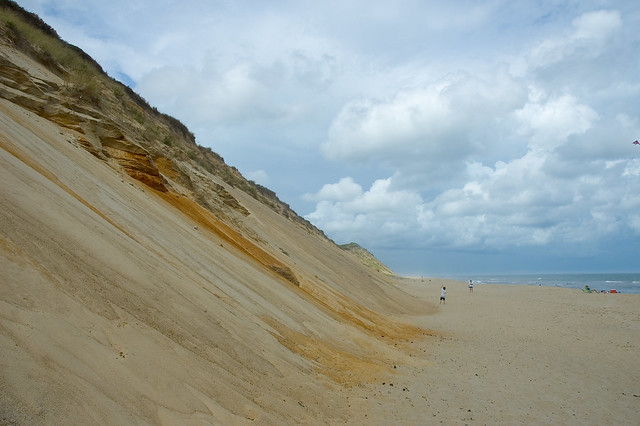
Other reminders of the presence of the massive ice cover in the region are cliffs above the dune fields — the edge of the glacial moraine (a pile of boulders pushed along as the ice pushed south) — and freshwater ponds of neighboring Truro and Wellfleet (“kettle holes” formed when stadium-sized chunks of ice broke off the glacier, became engulfed by glacial sediment, and then melted). All of these features stretch for miles and remind me and all my geologically time-traveling companions that 18,000 years ago — a seemingly long time — this portion of the Earth was covered by a one mile-thick sheet of ice.
 Wellfleet Bay Audubon Sanctuary. (photo: Susan Cole Kelly/Flickr, cc by-nc-sa 2.0)
Encountering this landscape cultivates in me, and I hope in my students, what Jewish scholar Abraham Joshua Heschel called “radical amazement.” For me, this is a soothing feeling of awe and connection. Walking in the dunes or across these mudflats puts me in touch with deep time — for the particles that compose them may themselves be millions of years old, silt and sand moved there merely thousands of years before.
Although we walk among them today, the particles have been through many cycles of existence. Formerly they were part of a mountainous land mass; subsequently they were eroded, transported, and deposited at least once. Each grain has an individual history. Collectively they tell a story that encompasses swaths of time that hold all of humanity. I find this reality comforting.
 The sands of Provincetown’s dunes. (photo: Leonarda DaSilva/Flickr, cc by-nc-nd 2.0)
Dr. Turkle worries helpfully about the inner effects of digital objects. Though she acknowledges the benefits of digital connection, Dr. Turkle laments what people lose as they take to the dunes and mudflats with their earphones in and handheld electronic devices on and open. To her mind, people lose the ability to feel at peace in their own company. I agree, but also would like to suggest that by unplugging from the electronic world in such sacred spaces we increase our capacity to encounter entities larger than ourselves — vast time scales, and past and ongoing earth processes. Thus we enhance our ability to connect with the earth system of which we are a powerful part, and this experience lessens loneliness.

 earthdharma.org