Island as Paleo-Sangha November 24, 2009
Posted by Jill S. Schneiderman in Barbados, Buddhist concepts, climate change, contemplative practice, earth community, geology.add a comment
This is cross-posted at Shambhala SunSpace.

I’ve been thinking about the upcoming Copenhagen United Nations climate change conference—the opportunity to secure agreements to reduce global greenhouse gas emissions that will replace the Kyoto Protocol before it expires—because this year I’ve been living on a tiny coral island in the Atlantic Ocean. Here in Barbados, everywhere I look with my geologist’s gaze I see evidence of past climate change. And in the daily newspapers I read reports that record the nation’s worries about the effects of climate change on islander’s livelihoods. As is true for other small island nations, the future of all living beings on Barbados depends on productive conversations in Copenhagen.
Barbados is a coral island that rose roughly 1200 feet above sea level in the last one million years—in other words, Barbados is a geological infant. Still, it has much to teach us. I’m reminded of a verse from Pablo Neruda’s poem “Keeping Quiet”:
“If we were not so single-minded
about keeping our lives moving,
and for once could do nothing,
perhaps a huge silence
might interrupt this sadness
of never understanding ourselves
and of threatening ourselves with death.
Perhaps the earth can teach us
As when everything seems dead
And later proves to be alive.” *
Though some sandstone and shale form a nucleus of the island, more than 85% of the exposed land consists of coral rock, known to geologists as limestone, naturally lithified from broken debris of ancient coral reefs. The island is unique in the Caribbean. Unlike the Bahamas that consist largely of windblown sand cemented together by the action of rainwater, or other Caribbean islands so vividly volcanic, Barbados today is comprised of nothing more than subaerial coralline remnants of dead communities and submarine fringes of currently living colonies of organisms—corals. Tiny animals called polyps that are related to and look like sea anemones, each coral encloses itself in a stony cup of limestone that it secretes. As they grow, the polyps divide to form coral colonies that build up on top of each other and manifest as a reef. Over thousands of years, coral reefs respond to fluctuations in sea level as well as changes in water temperature and other environmental conditions.
Abiding on this island I traverse slopes telling me that where I now walk, ocean waves once lapped. Hillsides shaped like treads and risers of a coralline staircase, coastal terraces in geological parlance, mark ancient shorelines. These old coastal features some distance above the modern coastline indicate that with changing climate and consequent sea level fluctuations some colonial organisms have become extinct while others have succeeded them. As a Jewish Buddhist geologist—or jubugeoscientist as I’ve come to think of myself lately—I think of these ancient reefs as paleo-Sanghas, communities that lived and died together.
In thinking about Buddhist responses to climate change, I’ve come to believe that Buddhist scientists must emphasize compassion and the ethical conduct components of the eightfold path—wise speech, wise action, wise livelihood. Though we scientists lead with our heads, I believe that we must add our hearts to our enterprise. From my observations of impermanent coral communities, my head knows that the living communities of Barbados will be vulnerable to inevitable sea level fluctuations. But as I behold the Barbadian’s Earth, I realize that scientist-negotiators going to Copenhagen must bring to conversations more than scientific wisdom; they must bring scientific heart.
Just before I left for an extended silent meditation retreat with Sylvia Boorstein and Sharon Salzberg last week, I read that world leaders had concluded that it would be unrealistic to strive for a legally binding agreement at the upcoming climate conference. Instead, the Danes have suggested that some Copenhagen aspirations could be salvaged through a “first-stage series of commitments rather than an all-encompassing protocol.” I have an alternative suggestion for the U.N. climate conference organizers prompted by my recent sit with Sylvia and Sharon: let negotiators not speak; let them live together and practice karuna and metta meditation as a community of retreatants for the twelve days set aside for the conference. By the end of that period, perhaps negotiator-retreatants will feel connected enough to one another and the home countries they each represent so that true giving will be possible. In preparation for the retreat I’d be happy to send them a piece of Barbados limestone for the altar.
* Italics mine
Jill S. Schneiderman is Professor of Earth Science at Vassar College. This year she received a Contemplative Practice Fellowship from the Center for Contemplative Mind in Society. She is editor of and contributor to For the Rock Record: Geologists on Intelligent Design (University of California Press, 2009) and The Earth Around Us: Maintaining a Livable Planet (Westview Press, 2003).
For more about Buddhism and Green Living, visit our special page on the topic here on ShambhalaSun.com.
Sustaining Contradictions August 11, 2009
Posted by Jill S. Schneiderman in contemplative practice, earth cycles, geology, mountain building.add a comment
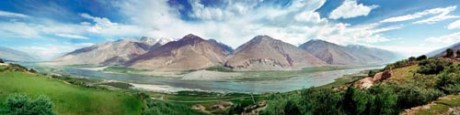
Yesterday I listened to Arthur Zajonc speak about the importance of sustaining contradiction in order to cultivate a deep epistemology of mind. Zajonc, professor of physics at Amherst College and scientific coordinator for the Mind and Life dialogue with H.H. the Dalai Lama, pointed out to our faculty group who had gathered for a contemplative pedagogy conference, that we must be able to sustain contradictions for ourselves and our students if we are to have a fresh experience of an object or a phenomenon. Physicists, he said, live with the wave-particle duality while mathematicians embrace the point at infinity.
Here I add to his list of sustained contradictions in the sciences a contribution from my own discipline, geology. As Arthur spoke, I saw the peaks of the Karakoram range in Northern Pakistan, a rugged landscape near Nanga Parbat that I helped map in 1990. This dynamic region at the confluence of the Pamir, Karakoram, Hindu Kush and Himalyan ranges—known as the roof of the world—is both rising up and wearing down simultaneously. Geologists study this spectacular orogen, created by the collision between the Asian and Indian lithospheric plates beginning 60 millions years ago, in order to examine questions such as how does continental lithosphere form? How are continents assembled? How are they reworked and deformed? Breathing laboriously at the highest altitudes on earth while stepping gingerly over unstable talus slopes, geologists doing the field work physically sustain contradictions.
 earthdharma.org