White Flags for Earth Day April 22, 2011
Posted by Jill S. Schneiderman in 'Eaarth' Day, earth community, earth cycles, earth system science, environmentalism, geologic time, Vassar College, White Flags.add a comment

As I’ve said before, I am somewhat cynical about Earth Day because it seems to me a travesty to focus on the Earth’s well-being just one day out of every year. It makes it seem as if Earth is some kind of static entity that we must pay tribute to whereas we know it to be a system of overlapping spheres (hydrosphere, atmosphere, rock sphere, and biosphere) whose interactions over extended time have made possible life on this planet. This is a fact that, in my opinion, we all should pause to appreciate every day.
So this Earth Day I’d like to call attention to “White Flags”–a project of Vassar’s 2010/2011 artist in residence, Aaron Fein. “White Flags”–all 192 flags of United Nations member states hand-made in white and installed on the College’s Chapel lawn–showcases the power of a physical environment that changes over time to illumine the transcendent connectedness of all living beings on this planet.
I’ve seen the flags and have been privileged to participate a bit in the project which is at the confluence of art and science. If you’re in the area, come see it between April 24 and April 29 at the College. It should be a magnificent sight.
The Japan Earthquake: Healing After Trauma March 14, 2011
Posted by Jill S. Schneiderman in disasters, earth community, earth system science, earthquakes, geology, Japan, science.add a comment
This piece is cross-posted at Shambhala SunSpace and Common Dreams.
I just returned from a weeklong spring break field trip in West Texas with my geology students to news of the 8.9 (now upgraded to 9.0) magnitude earthquake, and related 30-foot tsunami, nuclear reactor explosion and meltdowns, and oil refinery fire in Japan. In the El Paso airport on March 12, I picked up a copy of The Wall Street Journal to find out more about the events. The images of buildings, boats and other transport vehicles tossed willy-nilly by seawater—like toys swept aside by a frustrated child—took my breath away; they impressed on me yet again the spatial magnitude of Earth’s powerful forces.
I appreciated the clear rendering of the mechanisms of the quake and consequent tsunami— subduction of the Pacific plate beneath this outpost of the North American plate with massive uplift of the seafloor and displacement of voluminous amounts of seawater. Reporters for the Journalcontextualized the historic proportions of the seismic event (the fifth-largest recorded earthquake in the past century and the biggest in Japan in three hundred years); they lauded the country’s high degree of earthquake preparedness.
What struck me most, however was the extensive coverage of the economic implications of the quake for the global economy and speculations about how quickly life in and beyond Japan could get back to normal especially in terms of industrial and technological production. Of course I realize that business and financial news is that paper’s focus, nonetheless, I’d like to take the opportunity offered by this recent cascade of events to highlight a lesson that I think the Earth offers about reactions to stresses that can traumatize all living beings.
As readers of this blog know, I’m a seeker of Earth dharma—examples of Earth processes that resound with the wisdom of dharma teachers. For me, this recent temblor echoes teachings related to the devastating effects of the build-up of stress on a body and mindful approaches to healing.
In this seismic event, a locked fracture at the juncture of two lithospheric plates caused strain to accumulate in the rocks beneath the sea near the east coast of Honshu, Japan. It was released catastrophically as images of demolished landscapes and towns continue to show. As one geophysicist put it, “the rocks cracked under the pressure.”
I find it impossible not to take this as a metaphor for the effect on the human body of stress accumulated over the long-term and extract from it ideas about the delicacy of healing after such crises on earth. I’m sure others must have the same impulse but I feel especially inclined to it just coming off this field trip which took me to, among other places, Carlsbad Caverns (in New Mexico, just over the Texas border).
The moist, cool, subterranean world of Carlsbad Caverns beneath the rugged, desert landscape is an unparalleled realm of colossal chambers and extraordinary cave formations (known to geologists as speleothems). Formed a few million years ago by the dissolution of parts of a much older reef—the remains of sponges, algae and other marine invertebrate organisms that lived during the late Paleozoic—and then decorated beginning around 500,000 years ago, drop by drop, with crystals of calcite, steep passages connecting horizontal levels provide access to the Earth’s shallow interior.
While walking along the dimly lit paths through the caverns, I pointed out to one my medical school-bound students, “popcorn” speleothems precipitated so as to resemble, in my view, the alveoli of human lungs.
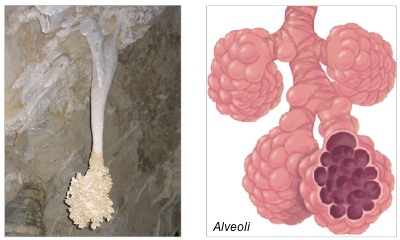
She marveled at the formation along with me. Then, further down the trail commented, “I feel like I’m walking inside the body of the Earth.” I couldn’t have agreed more.
Upon learning of the Japan quake, President Obama said at a news conference, “Today’s events remind us of just how fragile life can be.” Ostensibly sturdy, our Earth and all living beings on it are really quite delicate. The Prime Minister of Japan asserted that the current situation is the most severe crisis the country has faced since World War II and one that, in his words, will require people to join together in order to overcome the catastrophe. I agree that people will need to cooperate with one another but I think also that the current situation requires honesty (what is happening at those damaged reactors?) and patience. Is a focus on the possible effects of the catastrophe on the global economy a compassionate first response?
This portion of the Earth and the people who live there have experienced what my colleague David Applegate, senior science adviser for earthquakes at the U.S. Geological Survey has called a “low probability, high consequence” event. Foremost among my responses to the crisis, fresh from my recent intimate encounter with the Earth, is the wish that all living beings effected by this trauma be healed over the course of time.
Walkway Over the Hudson: Bird’s Eye Geology March 1, 2011
Posted by Jill S. Schneiderman in earth system science, geologic time, geology, Hudson Valley, The New Yorker, Walkway over the Hudson.add a comment

In the February 28 issue of The New Yorker, Ian Frazier has a lovely short piece entitled “Bridge” about the rejuvenation of the old Poughkeepsie-Highland Railroad bridge into what we Poughkeepsie-dwellers like to think of as the longest elevated pedestrian bridge in the world. For those who don’t subscribe to the magazine, you can access Frazier’s piece at the Walkway Over the Hudson website.
In my opinion, Ian Frazier has captured in words the remarkable world that one enters into while strolling on the bridge high above the Hudson River. He concludes his piece by stating, “Every once in a while, people need to be in the presence of things that are really far away.”
I know that Frazier means far away in space but I also think that people need to be aware of the fact that they are often in the presence of things that are really far away in time. The Walkway facilitates that as well because high above the River we have a bird’s eye view of the millions of years of Earth history that the Hudson Valley exposes.
For those whose curiosity about the valley is peaked by Frazier’s column, here’s a short piece that I wrote for the Poughkeepsie Journal,”Rocks Serve as Snapshot of Valley’s Timeline” that explains some of what walkers can engage as they stroll along our magnificent pedestrian bridge.
Rocks serve as snapshot of valley’s timeline
By Jill S. Schneiderman
For the Poughkeepsie Journal
The names Alexander Hamilton, Aaron Burr, George Washington, Benedict Arnold, Billy the Kid, Thomas Cole, Frederic Church, Edna St. Vincent Millay and Pete Seeger conjure up our region’s rich historic past.
But what of its prehistory? Rocks along both banks of the Hudson River and throughout its valley and adjacent mountains record a long and complex geologic history.
On this land, human history has played out. Much of the geologic drama occurred in prolonged pulses of activity during the Paleozoic, Mesozoic and Cenozoic Eras — 570 million years, but only the latest 13 percent of geologic time.
Though remarkable in the geologic scheme of things — uplift of Himalayan-sized mountains, spreading of inland seas of which there are no comparisons today save perhaps Canada’s Hudson’s Bay, tearing of continental crust, and burial by mile- thick ice — we read the record of these events in subtle clues from our area’s rocks.
Compared to human events over the last 400 years and those that will transpire in the next millennium, geology seems to provide a record of change whose pace requires patience.
As historians, geologists think from the past to the present — and so first we marvel at rocks of the Hudson Highlands. They begin near Anthony’s Nose, at the eastern edge of the Bear Mountain Bridge on the border of Westchester and Putnam counties. (It is named, according to legend, for the nose of Peter Stuyvesant’s trumpeter, Anthony Corlaer, who had a nose “of vast lusty size strutting boldly from his countenance like a mountain of Golconda”. Golgonda, India, the center of the diamond trade, denoted excess.)
The Highlands then run north to Breakneck and Storm King mountains, and they consist of more than 1 billion-year-old, coarsely crystalline granites and magnificent marble-cake gneisses. They are the bedrock of our area, the core of our continent, metamorphic rocks that tell us they’ve suffered intense pressures and temperatures from overlying rocks. Hard and unfractured — how remarkable it is that the deepest part of the Hudson River cuts through them.
Resources aid building boom
Cement from our region and crushed stone that have supplied New York’s building industry come from dolostones, magnesium-rich limestones north of the Highlands. New York Trap Rock at the Clinton Point quarry to this day mines this material, whose existence records the presence of a shallow sea that covered our area about 500 million years ago.
Closely associated with this carbonate rock is a shale that occurs throughout much of the Poughkeepsie area. This rock, too, is a marine sediment, akin to the material deposited in shallow offshore seaways. Though not especially rich in fossils, this rock unit, from the Ordovician period at least 435 million years ago, sometimes contains brachiopods, two-shelled marine organisms that superficially resemble but are substantially different from clams of today.
On both sides of the Hudson River in Poughkeepsie’s vicinity, topographically elevated regions of the Taconic mountains to the east and the Catskill mountains to the west remain as reminders of a geologically active time in our region’s past. Approximately 450 million years ago, an island chain much like Japan collided with North America and raised up the Taconic mountains. What’s left of them today is their roots.
Heated and crumpled, the Ordovician shale previously laid down on the shallow sea endured a kind of pressure-cooking that turned the shale into slate, which becomes coarser-grained schist as one travels east from Poughkeepsie into Connecticut. Beautiful red garnets, elongated white needles of sillimanite, and lustrous brown staurolite crystals adorn mica schists that sparkle in the sunlight as we go east toward the Taconic mountains on the border of northeastern Dutchess County.
Not long after this, we believe that a meteor may have hit the Earth just west of the current-day Hudson River at Panther Mountain in the Catskills. There, a circular pattern six miles across is formed by the Esopus and Woodland creeks. For streams to travel in a circle is very unusual and has led some investigators to suggest the presence of an impact crater in 400-million-year-old sedimentary rock that had previously been laid down in a shallow sea.
Because sediments were being deposited in the shallow sea, the crater was buried and preserved much like a fossil. The streams have carved out a circular outline around it though the crater itself remains completely buried.
After the Taconics rose in a mountain-building event known as an orogeny, the North American continent collided with an even larger land mass farther east. This orogenic event raised up the Acadian mountains, a chain of perhaps Himalayan proportions just east of the Taconics. Sediments shed from the Acadian mountains accumulated as blankets of conglomerate, sandstone and shale in a delta. Sediments of the Catskill Delta were almost two miles thick.
Today those sedimentary strata are visible as the Shawangunk and Catskill mountains. The Devonian sandstones of the Catskill Mountains, at least 345 million years old, are what have supplied the Catskill bluestone, blue from feldspar grains in it, for curbstone and flagstones throughout the United States.
Devonian limestones forming the spectacular escarpment overlooking the Mohawk and Hudson valleys contain an abundant assemblage of life that teemed in the area’s seas 345 million years ago. Stream beds cutting through the limestones at John Boyd Thatcher state park in Vorheesville show that corals, crinoids, trilobites and brachiopods thrived during that time.
A period of quiescence followed in this area until the Atlantic Ocean began to form. The spreading of continent crust that accompanied its formation tore the crust so valleys formed. Into them poured sediments, like those which today fill the lake- and flamingo-rich valleys of east Africa.
As dinosaurs stomped atop these sediments, magma (molten rock) was injected into them. To this magma we owe thanks for the magnificent Palisades on the west side of the Hudson River. For the next 185 million years, things were quiet in our region.
The next major episode of activity reflected in our rocks is glaciation. Though glaciers began to advance on the North American continent around 2 million years ago, our area records only the most recent advance of ice.
Approximately 40,000 years ago, the last glacial advance scraped over the area’s bedrock and sediments. When the ice retreated, it left behind a trail of kettle holes, moraines — sediments pushed aside like a snow plow creates drifts of snow — and glacial striations, scratch marks that we can see atop Bonticou Crag in the Mohonk Preserve of the Shawangunks in Ulster County and across the river into Millbrook in Dutchess. Perhaps most significant to valley residents, the ice carved a deep fjord which today is the Hudson River.
River forms in glacier’s wake
After the ice departed, the Hudson River became Glacial Lake Albany and Glacial Lake Hudson. Influxes of clays into those lakes ultimately supplied materials for the brickyards of our area. Sediment-laden glacial meltwaters continued to course down the Hudson, across today’s submarine continental shelf, and gouged out the Hudson River submarine canyon in today’s New York Harbor.
Thousands of years after the valley’s glaciation, humans evolved. Clearly, we have been on this planet only for a geological instant.
Despite this fact, people have managed to scar the surface of the Earth. Pits from quarry operations, PCBs (toxic industrial oils) in the bottom sediments of the Hudson River, metal-laden landfills, acidified lakes and streams each testify to that. Such transformations of natural resources affect our ability to provide what every human being deserves: clean soil, water and air.
Since we live on the eastern, passive edge of the North American continent, a place unlike the quake-plagued West Coast, we can be pretty sure that no catastrophic geologic change will occur in our area in the next millennium. But how we treat the Earth will profoundly affect our lives. We cannot afford to treat this planet as if it were an unending cornucopia of natural riches here for us to take and haphazardly discard. As we strive toward a sustainable future, we must all come to appreciate how the Earth works.
Buddhism and Science: Kin by Water July 15, 2010
Posted by Jill S. Schneiderman in Barbados, contemplative practice, earth cycles, earth system science, Francisco Varela, hydrologic cycle, hydrosphere, ice cores, meditation, Rabbi Jeff Roth, Rabbi Sheila Weinberg, science.add a comment
This piece is cross-posted at Shambhala SunSpace

Dr. Francisco Varela (1946-2001), a neuroscientist and Buddhist practitioner involved intimately in the initiative to foster dialogue and collaboration between modern scientists and Buddhist contemplatives, commented that Buddhism, as an outstanding source of observations concerning human mind and experience accumulated over centuries with great theoretical rigor, is an uncanny complement to science.
Appreciating this, Varela and others were able to cultivate a unique forum, the Mind and Life Institute, that for two decades has led conversations between the Dalai Lama and other Tibetan Buddhists and scientists, first from the realms of cognitive psychology and neurobiology and more recently, from physics and cosmology. In his essay “The Importance of the Encounter with Buddhism for Modern Science,” Varela wrote that the natural meeting ground between science and Buddhism is the place where we put together the data from scientific empiricism with the inner examination of human experience. When writing this, Varela had in mind particularly neuroscience, but I believe that earth science may also provide a fertile commons. Allow me to elucidate.
The other day, the sea drew me down the coral escarpment behind my apartment in Barbados for my morning sit. I walked downstairs and across the lawn, now turned emerald with the arrival of the rainy season. I swung outward the heavy iron gate—hinges squeaking—that opens onto the blue water of James Bay. The tide, on its way out, exposed squat, wave-washed pedestals of coral. I walked south with the sea on my right glittering aqua in the early morning sunshine, and found my seat—the water-worn stump of a tree whose girth suggested old age. I rooted my “sit bones” in the sand, my back touched gently what remained of the tree trunk, and I focused my attention on my breath.
Per instructions from my mindfulness teachers, Rabbis Sheila Peltz Weinberg and Jeff Roth, I had reflected all week on the question “Who am I in relation to sensations, feelings, and thoughts that arise and pass from moment to moment?” It arose in shortened form as a mantra during my meditation. With my eyes lightly shut, I saw the waves pulling the coralline sand and cobbles back into the sea, reclaiming that material—the solid calcium carbonate—that it had itself once produced collaboratively with the invertebrate organisms whose home is the sea.
My breathing felt fast and shallow. Was I anxious? Would I be able to settle myself here without my cushion? Worried mind hindered me. I began again. After some time my breathing came more slowly and from deeper down in my body. Along came another distraction familiar to any beachgoer—bugs. Were ants crawling on my leg? Had a fly landed on my neck? I felt annoyed and chastised myself for having chosen an inappropriate place to meditate. Had I deliberately set myself up for failure? Recognizing that I was again beset by another hindrance—doubt—I began again, again.
As I brought my awareness to my body, I discovered that the prickly sensation on my skin was not caused by crawling insects but by my own sweat—droplets of water leaving me. An answer to the question “What am I” became clear; I am part of the hydrosphere. The realization startled me. I already understood myself and other human beings as part of the biosphere, geosphere and atmosphere—the three of the four great interacting spheres that make up the Earth System. As with any living organism, some day I will become part of the solid substrate at the earth’s surface. Through my respiration I participate in the cycling of oxygen and carbon dioxide throughout the atmosphere. But I had not previously conceptualized myself as part of the hydrosphere—surprising, given that more than half of the human body is water.
Of course I know intellectually how we humans interact with the hydrologic cycle—how we commandeer water for industrial, agricultural and domestic purposes. But during this sit I realized myself to be one of the reservoirs of the hydrosphere, albeit a miniscule one. The hydrologic cycle is simple: precipitation falling from the atmosphere as snow accumulates in glaciers and ice caps—though these days there’s more melting than accumulating going on; rainwater from clouds along with meltwater from glaciers become streams, rivers, and lakes—“surface water” in geological parlance; that water soaks into the soil and percolates downward to become groundwater and soil moisture, or it gets incorporated into living matter; ultimately it all flows back to the oceans. Evaporation of water into the atmosphere occurs throughout the hydrologic cycle, but especially from the ocean—the largest of all the reservoirs—and the cycle begins again.

Geologists know empirically something of the history of fossil waters—essentially water entombed for long periods of time in one part of the hydrologic cycle, most typically in the form of groundwater —from studying the oxygen isotopic composition of fluids in geological artifacts such as slices of Antarctic ice (H2O) cores and calcite (CaCO3) in sand-sized deep marine fossils called foraminifera. Put simply, some elements—isotopes—occur as two varieties of the same substance one of which is slightly heavier than the other. Remember Goobers and Raisinets? As chocolate-covered fruits, they are arguably the same confection. (I’m one to pass on the raisinets, preferring the goobers, but this isn’t the venue for detailing their respective virtues). Yet, the goobers are heavier than the raisinets because their insides differ. The same is true for oxygen. One variety of oxygen is the light “oxygen-16” (O16) while another is the heavy “oxygen-18” (O18); they are isotopes of oxygen just as raisinets and goobers are isotopes of chocolate candies—sort of. And if you’ve persisted in following me this far, thank you, and hang in there for I intend to make good on the promise of linking earth science and Buddhist thought.
When water evaporates from oceans, it’s the lighter H2O16 that gets incorporated preferentially into clouds. Therefore, during cold periods in the geological past, when more water is stored in ice caps, seawater concentrates H2O18 in it. That is, since it’s harder for H2O18 to get lifted up into the atmosphere, so to speak, it gets left behind in the ocean. By analogy, think of whether you’d rather heft your jacket or suitcase into the overhead compartment in an airplane and you’ll understand why some heavy items—not all—remain “stowed beneath the seat in front of you” while the lighter ones go into the upper bins. When paleoclimatologists investigate the cold periods in earth history—glacial ages— when more of the hydrosphere’s water stays sequestered in ice, they find that ice core samples from these cold times have more H2O16 in them than they do H2O18. In like manner, calcium carbonate from ice-age foraminifera, tends to be relatively enriched in O18 (as well as the heavier of two carbon isotopes). Paleontologists analyzing their composition find they have relatively more CaC(O18)3 than CaC(O16)3 . It’s clever science but unarguably esoteric business, this isotope geochemistry. It requires ice cores kept frozen from Antarctica to lab, analysis of fluid bubbles enclosed in the ice, and specialized machines called mass spectrometers that can measure miniscule differences in the weight of oxygen atoms. It also requires mathematical calculations that I found tedious in graduate school. Still, all of that is not as difficult as staying focused on my breath.
I sat sweating, and the water droplets from my body connected me to the hydrosphere. Where had that water been before—the water that makes up me? Was part of me once a glacier? Was I a mountain stream? What tale might the oxygen isotopic signature of my bones, calcium phosphate (PO4) tell?
As the perspiration dripped down my shins, it disappeared in the pores between unconsolidated beach sand. Water from the reservoir of me meandered to the sea as moisture between sand grains. The sweat trickling down my spine slid down my back and disappeared into the wood of the tree stump. This “Jillwater” will remain for some time in the soggy wood and won’t soon join the vast oceanic reservoir of the hydrosphere. I finished my sit and rose slowly.
I walked to the water’s edge and felt its cool wetness envelope my toes, the soles of my feet, my ankles and shins. The sea sipped directly the sweat from my skin. These droplets that have eked out of me flowed unimpeded to the ocean. As seawater may one day become part of an ice cap, the water from me will be a drop in the sea.
The dialogue between science and Buddhism has the potential to develop specific interventions that could promote not only psychological and physical wellbeing but planetary health too. Modern earth science allows that human beings interact with the earth system and, to a degree, try to serve as stewards of the planet. But Buddhism offers earth science the possibility of a more unified understanding of the Earth, a science that frames humans as kin rather than stewards of the planet.
See also:
- More “Earth Dharma” posts by Jill S. Schneiderman
- “Two Sciences of Mind” — Barry Boyce on Francisco Varela, “a walking Buddhism-science dialogue.”
 earthdharma.org