Buddhism and Science: Kin by Water July 15, 2010
Posted by Jill S. Schneiderman in Barbados, contemplative practice, earth cycles, earth system science, Francisco Varela, hydrologic cycle, hydrosphere, ice cores, meditation, Rabbi Jeff Roth, Rabbi Sheila Weinberg, science.add a comment
This piece is cross-posted at Shambhala SunSpace

Dr. Francisco Varela (1946-2001), a neuroscientist and Buddhist practitioner involved intimately in the initiative to foster dialogue and collaboration between modern scientists and Buddhist contemplatives, commented that Buddhism, as an outstanding source of observations concerning human mind and experience accumulated over centuries with great theoretical rigor, is an uncanny complement to science.
Appreciating this, Varela and others were able to cultivate a unique forum, the Mind and Life Institute, that for two decades has led conversations between the Dalai Lama and other Tibetan Buddhists and scientists, first from the realms of cognitive psychology and neurobiology and more recently, from physics and cosmology. In his essay “The Importance of the Encounter with Buddhism for Modern Science,” Varela wrote that the natural meeting ground between science and Buddhism is the place where we put together the data from scientific empiricism with the inner examination of human experience. When writing this, Varela had in mind particularly neuroscience, but I believe that earth science may also provide a fertile commons. Allow me to elucidate.
The other day, the sea drew me down the coral escarpment behind my apartment in Barbados for my morning sit. I walked downstairs and across the lawn, now turned emerald with the arrival of the rainy season. I swung outward the heavy iron gate—hinges squeaking—that opens onto the blue water of James Bay. The tide, on its way out, exposed squat, wave-washed pedestals of coral. I walked south with the sea on my right glittering aqua in the early morning sunshine, and found my seat—the water-worn stump of a tree whose girth suggested old age. I rooted my “sit bones” in the sand, my back touched gently what remained of the tree trunk, and I focused my attention on my breath.
Per instructions from my mindfulness teachers, Rabbis Sheila Peltz Weinberg and Jeff Roth, I had reflected all week on the question “Who am I in relation to sensations, feelings, and thoughts that arise and pass from moment to moment?” It arose in shortened form as a mantra during my meditation. With my eyes lightly shut, I saw the waves pulling the coralline sand and cobbles back into the sea, reclaiming that material—the solid calcium carbonate—that it had itself once produced collaboratively with the invertebrate organisms whose home is the sea.
My breathing felt fast and shallow. Was I anxious? Would I be able to settle myself here without my cushion? Worried mind hindered me. I began again. After some time my breathing came more slowly and from deeper down in my body. Along came another distraction familiar to any beachgoer—bugs. Were ants crawling on my leg? Had a fly landed on my neck? I felt annoyed and chastised myself for having chosen an inappropriate place to meditate. Had I deliberately set myself up for failure? Recognizing that I was again beset by another hindrance—doubt—I began again, again.
As I brought my awareness to my body, I discovered that the prickly sensation on my skin was not caused by crawling insects but by my own sweat—droplets of water leaving me. An answer to the question “What am I” became clear; I am part of the hydrosphere. The realization startled me. I already understood myself and other human beings as part of the biosphere, geosphere and atmosphere—the three of the four great interacting spheres that make up the Earth System. As with any living organism, some day I will become part of the solid substrate at the earth’s surface. Through my respiration I participate in the cycling of oxygen and carbon dioxide throughout the atmosphere. But I had not previously conceptualized myself as part of the hydrosphere—surprising, given that more than half of the human body is water.
Of course I know intellectually how we humans interact with the hydrologic cycle—how we commandeer water for industrial, agricultural and domestic purposes. But during this sit I realized myself to be one of the reservoirs of the hydrosphere, albeit a miniscule one. The hydrologic cycle is simple: precipitation falling from the atmosphere as snow accumulates in glaciers and ice caps—though these days there’s more melting than accumulating going on; rainwater from clouds along with meltwater from glaciers become streams, rivers, and lakes—“surface water” in geological parlance; that water soaks into the soil and percolates downward to become groundwater and soil moisture, or it gets incorporated into living matter; ultimately it all flows back to the oceans. Evaporation of water into the atmosphere occurs throughout the hydrologic cycle, but especially from the ocean—the largest of all the reservoirs—and the cycle begins again.

Geologists know empirically something of the history of fossil waters—essentially water entombed for long periods of time in one part of the hydrologic cycle, most typically in the form of groundwater —from studying the oxygen isotopic composition of fluids in geological artifacts such as slices of Antarctic ice (H2O) cores and calcite (CaCO3) in sand-sized deep marine fossils called foraminifera. Put simply, some elements—isotopes—occur as two varieties of the same substance one of which is slightly heavier than the other. Remember Goobers and Raisinets? As chocolate-covered fruits, they are arguably the same confection. (I’m one to pass on the raisinets, preferring the goobers, but this isn’t the venue for detailing their respective virtues). Yet, the goobers are heavier than the raisinets because their insides differ. The same is true for oxygen. One variety of oxygen is the light “oxygen-16” (O16) while another is the heavy “oxygen-18” (O18); they are isotopes of oxygen just as raisinets and goobers are isotopes of chocolate candies—sort of. And if you’ve persisted in following me this far, thank you, and hang in there for I intend to make good on the promise of linking earth science and Buddhist thought.
When water evaporates from oceans, it’s the lighter H2O16 that gets incorporated preferentially into clouds. Therefore, during cold periods in the geological past, when more water is stored in ice caps, seawater concentrates H2O18 in it. That is, since it’s harder for H2O18 to get lifted up into the atmosphere, so to speak, it gets left behind in the ocean. By analogy, think of whether you’d rather heft your jacket or suitcase into the overhead compartment in an airplane and you’ll understand why some heavy items—not all—remain “stowed beneath the seat in front of you” while the lighter ones go into the upper bins. When paleoclimatologists investigate the cold periods in earth history—glacial ages— when more of the hydrosphere’s water stays sequestered in ice, they find that ice core samples from these cold times have more H2O16 in them than they do H2O18. In like manner, calcium carbonate from ice-age foraminifera, tends to be relatively enriched in O18 (as well as the heavier of two carbon isotopes). Paleontologists analyzing their composition find they have relatively more CaC(O18)3 than CaC(O16)3 . It’s clever science but unarguably esoteric business, this isotope geochemistry. It requires ice cores kept frozen from Antarctica to lab, analysis of fluid bubbles enclosed in the ice, and specialized machines called mass spectrometers that can measure miniscule differences in the weight of oxygen atoms. It also requires mathematical calculations that I found tedious in graduate school. Still, all of that is not as difficult as staying focused on my breath.
I sat sweating, and the water droplets from my body connected me to the hydrosphere. Where had that water been before—the water that makes up me? Was part of me once a glacier? Was I a mountain stream? What tale might the oxygen isotopic signature of my bones, calcium phosphate (PO4) tell?
As the perspiration dripped down my shins, it disappeared in the pores between unconsolidated beach sand. Water from the reservoir of me meandered to the sea as moisture between sand grains. The sweat trickling down my spine slid down my back and disappeared into the wood of the tree stump. This “Jillwater” will remain for some time in the soggy wood and won’t soon join the vast oceanic reservoir of the hydrosphere. I finished my sit and rose slowly.
I walked to the water’s edge and felt its cool wetness envelope my toes, the soles of my feet, my ankles and shins. The sea sipped directly the sweat from my skin. These droplets that have eked out of me flowed unimpeded to the ocean. As seawater may one day become part of an ice cap, the water from me will be a drop in the sea.
The dialogue between science and Buddhism has the potential to develop specific interventions that could promote not only psychological and physical wellbeing but planetary health too. Modern earth science allows that human beings interact with the earth system and, to a degree, try to serve as stewards of the planet. But Buddhism offers earth science the possibility of a more unified understanding of the Earth, a science that frames humans as kin rather than stewards of the planet.
See also:
- More “Earth Dharma” posts by Jill S. Schneiderman
- “Two Sciences of Mind” — Barry Boyce on Francisco Varela, “a walking Buddhism-science dialogue.”
Slow Violence in the Gulf of Mexico: A Buddhist Response June 4, 2010
Posted by Jill S. Schneiderman in BP/Deepwater Horizon oil catastrophe, Buddhist concepts, contemplative practice, disasters, earth community, fossil fuel, geology, oil, oil spill.add a comment
This piece is cross-posted at Shambhala SunSpace and Common Dreams.org
 The U.S. government and reporters have gone from calling the BP/Transocean calamity an accident to referring to it as an environmental crime. In my opinion, that’s an improvement in verbal accuracy but it misses an even larger and vastly important point. We are now witnessing in the Gulf of Mexico slow violence. Writer Rob Nixon coined the phrase, which he acknowledges as seemingly oxymoronic, to describe acts whose “lethal repercussions sprawl across space and time.”
Would anyone argue that the exploits of oil professionals in the Gulf haven’t caused deadly outcomes that continue to sprawl spatially and temporally? If the implications of the words Nixon uses to help us understand his concept were not utterly devastating, I’d relish their richness: “attritional calamities” with “deferred consequences and casualties;” “dispersed repercussions” that “pose formidable imaginative difficulties.” The explosion, fire, and sinking of the Deepwater Horizon was a small spectacle and only the initial phase of a protracted series of events with severe ramifications. I believe that Nixon would call the BP Earth Day Oil Catastrophe a “convoluted cataclysm”; it’s vivified by the tortuous patterns of unspectacular brick-colored sludge and oblique oily sheen not anywhere but everywhere. The crude oil coats birds, porpoises, redfish, marsh grasses, and people. It’s dispersed in the water column and currents, and sends fumes into the air.
.
 Oil in the Gulf. Image via NASA.
It’s difficult not to be heartbroken. Amy Goodman, host of Democracy Now, reported from coastal Louisiana the sentiments of people whose lives and livelihoods are wrecked. When asked to talk about the damage, fifty-one year old Dean Blanchard, owner of the largest shrimp business in the area of Grand Isle responded, “It’s not the damage. It’s a way of life. They destroyed a way of life.” In the parking lot of his tattoo parlor Bobby Pitre displayed a sculpture of an adult and child, both wearing gas masks, holding a dead fish by the tail and a sign, “God help us all!” When talking to Goodman he said, “I don’t think there’s anything that man can do at this point to really prevent the spill from reaching us, reaching our marshes….we need a miracle, is what we really need, you know? That’s how I see it. It’s going to kill everything in our marshes, our whole way of life. It’s just going to kill us, you know?”
Devastated communities and environmental refugees, dead or injured living beings, and absolutely altered land, water, and air. We should recognize the BP Earth Day Oil Catastrophe as a bellwether of slow violence—brutality in the guise of slow-moving and spatially extensive environmental transformations that are out of sync with the nano-second attention spans of the 21st century. But what will enable us unflaggingly to confront slow violence?
In her memoir, Faith: Trusting Your Own Deepest Experience, Sharon Salzberg writes, “When we stand before a chasm of futility, it is first of all faith in this [the] larger perspective that enables us to go on.” Some might scoff at the idea that faith has any place as a healing quality, a refuge, during this calamity and in the future it foreshadows. But human beings must begin to live and act in accordance with the reality of connectedness famously articulated by John Muir: “When we try to pick out anything by itself we find that it is bound fast by a thousand invisible cords that cannot be broken, to everything in the universe. ”
Salzberg advocates for an enduring faith in, among other things, the recurrent workings of nature. She reports after the U.S. bombed Hiroshima, panic erupted as rumors spread that grass, trees, and flowers would never again grow in the city. She writes:
“Had the disaster been of such proportions that the laws of nature had exploded with the bomb? As we know, even in the face of massive human intervention, the grass and trees and flowers did grow again in Hiroshima. Several people, describing their experience of that time, say that it was only once they learned that natural law was still intact that they had the faith to go on.”
Natural law still operates amidst the ineptitude and corruption in the Gulf of Mexico. Distributary channels on the Mississippi delta continue to carry sediment to the Gulf despite human efforts to channelize the flow of the river; tides and currents dole out the sediment to the sea; fine-grained particles settle to the seafloor. It’s the modern day continuation of processes that first formed the oil. The petroleum—“rock oil”—now gushing forth from the earth’s crust is a natural substance, albeit unleashed in an unnatural time frame. It formed from the remains of marine organisms interred in mud beneath the sea. Over millions of years, the mud compressed and heated to form the sedimentary rock, shale. In that process the contained organic matter broke down to form oil. In the record of rocks, like those that spew oil, I read rhythms of deep time and the renewal they imply.
James Hutton, the 18th century Scottish medical doctor and gentleman farmer, is considered the founder of geology and remembered as having likened the earth to a perpetually self-renewing machine. But as essayist Loren Eiseley reminds us in The Firmament of Time, for his doctoral dissertation Hutton studied blood circulation. At the same time, the medieval idea persisted that Man reproduces in miniature the outside world. What has been called Hutton’s secret—the fact that as a physician he applied his biomedical perspective to the earth—allowed him to use an organismic analogy for the earth. He conceived of the planet not simply as a machine but as a living organism with circulation and metabolism. In this way of seeing, it is possible to recognize dynamic qualities of the earth’s crust that facilitate decay and renewal.
As Sharon Salzberg advises, “with faith we can draw near to the truth of the present moment.” So, for the time being, as I follow the ongoing reports coming from coastal Louisiana, I’m clinging to my faith as a geoscientist that we and the Earth together can begin again.
Click here for more of Jill S. Schneiderman’s “Earth Dharma” posts for Shambhala SunSpace.
This entry was created by Jill S. Schneiderman, posted on June 4, 2010 at 10:32 am and tagged Environment, Science, Sustainability. Bookmark the permalink. Follow any comments here with the RSS feed for this post.
‘Eaarth’ Gay on ‘Eaarth’ Day 2010 April 22, 2010
Posted by Jill S. Schneiderman in 'Eaarth' Day, Buddhist concepts, climate change, contemplative practice, earth community, environmental justice, LGBT concerns, Vassar College.5 comments

Sometimes I feel blasé about Earth Day because I grow tired of talk without action. As a bujugeoscientist (that’s a Buddhist, Jewish, geoscientist) I’m inclined towards Right Speech and Right Action among the steps of the eightfold-path. As a result, I am unmoved by the verbiage of Earth Day.
Founded with good intentions by Senator Gaylord Nelson forty years ago today, it was designed as an environmental “teach-in” to inspire awareness and appreciation for the Earth’s environment. But I think it’s time for the speechifying (and partying that sometimes goes with it) to be supplanted by serious (right) action.
So, I’m pleased to share my delight today at having stumbled upon a new organization, OUT for Sustainability that aims to engage and mobilize the LGBT community around progressive environmental thinking. In my opinion, environmentalists like those running Earth Day events can learn plenty from LGBT activists who have had to mobilize swiftly to fight life-threatening illness and counter gross civil rights injustices.
The current state of Eaarth should move Eaarthlings as the AIDS-crisis moved LGBT activists. Started in 2009, OUT for Sustainability seems to me to represent the type of alliances this planet and its living beings need now. My queer Vassar College students get this connection; for example, they are OUT working on advanced degrees in epidemiology and environmental science; serving as educators about climate change; directing films about the effects of Hurricane Katrina; and promoting organizations that focus on issues of environmental justice, including food justice and health.
Thank you students! Thank you OUT for Sustainability. On Eaarth Day 2010, this Eaarth Gay feels inspired.
After Yushu, Hindered by Doubt April 19, 2010
Posted by Jill S. Schneiderman in contemplative practice, disasters, earthquakes, geology, Iceland, mountain building.add a comment
This piece is cross-posted at Shambhala SunSpace.
With the earth functioning for me as an object on which to meditate, or at least as a source of teachings that resonate with Buddhadharma, doubt is the hindrance that shakes my ability to use earthdharma to cultivate equanimity in light of the April 13 earthquake in Qinghai Province, China. Scientific understanding of earth processes has enhanced my capacity to access Buddhadharma, but at this moment it’s hard for me to regard the earthquake dispassionately and simply as a manifestation of the earth’s dynamism and propensity to change.
It’s true that this earthquake occurred because of the sideways slipping between two lithospheric plates—the same kind of motion that caused the 2010 Port-au-Prince earthquake I’ve previously written about for this blog. The eastern Tibet Plateau is a geologically complex region where the Indian and Eurasian lithospheric plates converge; you can picture what’s happening in the earth’s crust there by imagining the configuration and forces that result when you eject a seed from between the thumb and pointer finger of your left hand, the Tibetan plateau being the seed.
Enormous forces are at work there. The Indian plate is moving northward, toward the Eurasian plate—your thumb and forefinger in my analogy, respectively—at a rate of 46 millimeters per year. It’s that convergence that drives the uplift of the magnificent Himalaya at a rate of 10 millimeters per year to form what we geologists refer to as “the roof of the world.”
I know with my geoscientist’s mind that the 6.9 magnitude temblor likely reflects the interplay among the major tectonic (mountain building) forces along the Kunlun fault system that runs approximately 300 kilometers north of the epicenter of the seismic event. This tremor is one of the largest known quakes within several hundred kilometers of this location; one with similar magnitude occurred nearby in 1738.
Regardless, my scientist’s heart feels the vicissitudes of pain and loss when I read that hundreds of people have been killed and thousands injured and buried under debris, many of them peaceful ethnic Tibetan farmers and herdsmen like those I encountered on excursions in Qinghai province in the summer of 2008, just after the devastating Sichuan earthquake. I experience the unpleasant feeling tone that accompanies my geoscientific knowledge. And my heart doubts what my head grasps.
I’ve been asked often in 2010 if the frequency of earthquakes is increasing. My mind comprehends that although it may seem that we are having more earthquakes, the U.S. Geological Survey (USGS) reports that quakes of magnitude 7 or greater have remained essentially constant. I accept the partial explanation that, according to the USGS, in the last two decades we have been able to locate more earthquakes because of vast, improved and rapid global communication systems and the higher number of seismograph stations in the world than ever before. These conditions cause a 21st-century population that is already quite concerned about environment and hazards to learn about these earthquakes as they happen. Historical records suggest that we should expect annually one great earthquake (above 8), 15 major quakes (7-7.9) and 134 tremors of 6 to 6.9 magnitudes. By this accounting, the year 2010 has offered no greater seismic hazard than usual.
I try to see this latest earthquake as evidence of cyclic impermanence and Earth renewal. Still, my scientist’s heart aches. I set down my pen to sit so that I might cultivate both compassion in my heart for the living beings of that region, and equanimity that can help me along the path of using geoscientific insight to reduce suffering.
Previously:
- His Holiness the Karmapa on the Yushu earthquake
- Want to help post-earthquake relief efforts in Tibet? Check out our “Helping Tibet” page
- UPDATES: 6.9 earthquake in China/Tibet border region kills hundreds; homes and schools devastated; damages, casualties at Thrangu Rinpoche’s monastery reported; Dalai Lama statement; how to help
This entry was created by Jill S. Schneiderman, posted on April 18, 2010 at 11:14 am and tagged China, Death & Dying, Environment, Science, Tibet. Bookmark the permalink. Follow any comments here with the RSS feed for this post.


Trackbacks are closed, but you can post a comment
Island as Paleo-Sangha November 24, 2009
Posted by Jill S. Schneiderman in Barbados, Buddhist concepts, climate change, contemplative practice, earth community, geology.add a comment
This is cross-posted at Shambhala SunSpace.

I’ve been thinking about the upcoming Copenhagen United Nations climate change conference—the opportunity to secure agreements to reduce global greenhouse gas emissions that will replace the Kyoto Protocol before it expires—because this year I’ve been living on a tiny coral island in the Atlantic Ocean. Here in Barbados, everywhere I look with my geologist’s gaze I see evidence of past climate change. And in the daily newspapers I read reports that record the nation’s worries about the effects of climate change on islander’s livelihoods. As is true for other small island nations, the future of all living beings on Barbados depends on productive conversations in Copenhagen.
Barbados is a coral island that rose roughly 1200 feet above sea level in the last one million years—in other words, Barbados is a geological infant. Still, it has much to teach us. I’m reminded of a verse from Pablo Neruda’s poem “Keeping Quiet”:
“If we were not so single-minded
about keeping our lives moving,
and for once could do nothing,
perhaps a huge silence
might interrupt this sadness
of never understanding ourselves
and of threatening ourselves with death.
Perhaps the earth can teach us
As when everything seems dead
And later proves to be alive.” *
Though some sandstone and shale form a nucleus of the island, more than 85% of the exposed land consists of coral rock, known to geologists as limestone, naturally lithified from broken debris of ancient coral reefs. The island is unique in the Caribbean. Unlike the Bahamas that consist largely of windblown sand cemented together by the action of rainwater, or other Caribbean islands so vividly volcanic, Barbados today is comprised of nothing more than subaerial coralline remnants of dead communities and submarine fringes of currently living colonies of organisms—corals. Tiny animals called polyps that are related to and look like sea anemones, each coral encloses itself in a stony cup of limestone that it secretes. As they grow, the polyps divide to form coral colonies that build up on top of each other and manifest as a reef. Over thousands of years, coral reefs respond to fluctuations in sea level as well as changes in water temperature and other environmental conditions.
Abiding on this island I traverse slopes telling me that where I now walk, ocean waves once lapped. Hillsides shaped like treads and risers of a coralline staircase, coastal terraces in geological parlance, mark ancient shorelines. These old coastal features some distance above the modern coastline indicate that with changing climate and consequent sea level fluctuations some colonial organisms have become extinct while others have succeeded them. As a Jewish Buddhist geologist—or jubugeoscientist as I’ve come to think of myself lately—I think of these ancient reefs as paleo-Sanghas, communities that lived and died together.
In thinking about Buddhist responses to climate change, I’ve come to believe that Buddhist scientists must emphasize compassion and the ethical conduct components of the eightfold path—wise speech, wise action, wise livelihood. Though we scientists lead with our heads, I believe that we must add our hearts to our enterprise. From my observations of impermanent coral communities, my head knows that the living communities of Barbados will be vulnerable to inevitable sea level fluctuations. But as I behold the Barbadian’s Earth, I realize that scientist-negotiators going to Copenhagen must bring to conversations more than scientific wisdom; they must bring scientific heart.
Just before I left for an extended silent meditation retreat with Sylvia Boorstein and Sharon Salzberg last week, I read that world leaders had concluded that it would be unrealistic to strive for a legally binding agreement at the upcoming climate conference. Instead, the Danes have suggested that some Copenhagen aspirations could be salvaged through a “first-stage series of commitments rather than an all-encompassing protocol.” I have an alternative suggestion for the U.N. climate conference organizers prompted by my recent sit with Sylvia and Sharon: let negotiators not speak; let them live together and practice karuna and metta meditation as a community of retreatants for the twelve days set aside for the conference. By the end of that period, perhaps negotiator-retreatants will feel connected enough to one another and the home countries they each represent so that true giving will be possible. In preparation for the retreat I’d be happy to send them a piece of Barbados limestone for the altar.
* Italics mine
Jill S. Schneiderman is Professor of Earth Science at Vassar College. This year she received a Contemplative Practice Fellowship from the Center for Contemplative Mind in Society. She is editor of and contributor to For the Rock Record: Geologists on Intelligent Design (University of California Press, 2009) and The Earth Around Us: Maintaining a Livable Planet (Westview Press, 2003).
For more about Buddhism and Green Living, visit our special page on the topic here on ShambhalaSun.com.
Contemplating Sabbatical September 28, 2009
Posted by Jill S. Schneiderman in contemplative practice, sabbatical.3 comments

To every thing there is a season, and a time to every purpose under the heaven:
A time to be born, and a time to die; a time to plant; and a time to pluck up that which is planted;
A time to kill, and a time to heal; a time to break down, and a time to build up;
A time to weep, and a time to laugh; a time to mourn, and a time to dance;
A time to cast away stones, and a time to gather stones together; a time to embrace, and a time to refrain from embracing;
A time to get, and a time to lose; a time to keep, and a time to cast away;
A time to rend, and a time to sew; a time to keep silence and a time to speak;
A time to love, and a time to hate; a time of war, and a time of peace.
–Ecclesiastes 3: 1-8.
It feels, and indeed is impossible to write down these words without singing the words to the Byrds’ tune “Turn, Turn, Turn.” In fact, I had to put down my pen and sing them. They feel rejoiceful, to turn my own phrase.
I remember the first time that I learned that the words for the song came from the bible, Ecclesiastes in particular. I was sitting in Steve Gould’s History of Earth class, listening to him lecture about time’s arrow and time’s cycle, linear and cyclical time, the subject of the book on which he was working at the time. It opened my mind to the possibility of finding wisdom in the Bible. It was a startling recognition for me because up until that point I thought of religion as a source of oppression, mostly.
I guess there is some poetry to the fact that I am now rereading Gould’s relatively uncelebrated Time’s Arrow, Time’s Cycle: Myth and Metaphor in the Discovery of Geological Time (Harvard University Press, 1987). This book above all others has been my academic bible since I first encountered Steve twenty-five years ago as a graduate student. His consideration of deep time along with other fundamentals of geology, such as the igneous nature of granite, has fueled my teaching and thinking over the past quarter century.
Sabbatical years run from one Rosh Ha-Shanah to the next. And here I sit, erev Rosh Ha-Shanah, the biblical beginning of my sabbatical year, thinking about time and shmita (the biblical sabbatical year), Jubilee year and meditation. How am I to use this time? Though I haven’t consulted it recently, my institution’s faculty governance is probably spare in describing the purpose of sabbatical leave. And this is not my first, not my second, nor merely my third sabbatical, so one might wonder, why do I wonder about it? In fact, I’ve been thinking about this sabbatical as my Jubilee year sabbatical. As scholars more qualified to speak on this matter than I have pointed out, sabbatical has a biblical origin rooted in rest and spiritual regeneration.
According to Genesis, God created the earth and all its life in six days, and on the seventh day God rested, hence the seventh day as a Sabbath, a day of rest. Additionally, other books of the old Testament describe the sabbatical year, the seventh year of the seven-year agricultural cycle mandated by the Torah for the Land of Israel, in which tillers of the earth let the ground lie fallow, debts are forgiven, slaves are freed. I wonder how many of my academic colleagues recognize the biblical origin of sabbaticals every seventh semester or every seventh year (for those of us fortunate enough to be faculty at institutions that offer them). I’ve questioned a few of my colleagues about this and it has escaped the attention of most whom I’ve asked. Of course, I’m faculty at a religiously unaffiliated institution. Perhaps it’s different at Jesuit and other religious institutions of higher education.
For me, this sabbatical year has special significance. I’ve not had seven sabbaticals but this year I am fifty years old. According to the Bible, the sabbatical year was originally part of a 50-year cycle of which the climax was the Jubilee year when all land was returned to its ancestral owners and Hebrew slaves who had chosen to remain in service after the biblical six-year maximum were released. It feels right to me to plan to spend this special sabbatical year resting, and being, and contemplating time.
A Contemplative Practice Fellowship from the Center for Contemplative Mind in Society enables me to undertake this project, if one should even call it that, because the fellowship validates the endeavor. I’m reading about time; returning to the season of my earliest intellectual coming of age; considering directional time and cycling time; trying to understand how different cultures, and religious/spiritual traditions have lived with it; hoping to find a way to develop a course on the subject as I promised the Center; and looking for ways to address with my colleagues the problem that University of Washington, information technology professor David Levy refers to as “no time to think.”
There’s irony in making something of a sabbatical. The Googling I’ve done to see what others have written about the origins of academic sabbaticals leads me to a paucity of papers—a bit of history, a bit more about harnessing employees’ potential and utility for an institution or business. Most everything I read moves quickly beyond what seems to me to be the essence of sabbatical: renewal of spirit and intellect as they seek meaning and value in life.
I sit and gaze at the orange and green photograph of a robed Thai monk looking pensively across a small, still lily pond. A photographer friend and colleague gave me the photo more than a decade ago and it has traveled with me from the west coast of the U.S. to east, from house to dorm faculty apartment to house as if accompanying me because it would one day be significant beyond its attractive color and composition. It’s my purpose to sit, to be still, during my Jubilee sabbatical, and see what arises. I’m bolstered by having removed myself from the United States to accompany my spouse on her Fulbright to the University of the West Indies in Barbados, the country in the western hemisphere with the oldest known synagogue founded in 1654 by Sephardic Jews fleeing persecution in Brazil. Physically away from demands of colleagues and expectations of students, I’m facilitating this opportunity to let the terrain of my mind lie fallow, to meditate to see what arises. This is the convergence of my contemplative practice fellowship and my sabbatical year. So to all my colleagues beginning sabbatical l’shana tova, let the sweet new year begin.
—
On Contemplative Times August 15, 2009
Posted by Jill S. Schneiderman in contemplative practice, earth cycles, hydrologic cycle.7 comments
 A recent New York Times Op-Ed (August 14, 2009) contained the piece “Thirsting for Fountains.” According to the editors, they asked eight illustrators to observe for one hour the activity at a local water fountain. Their rationale: “If drinking fountains were as ubiquitous as fire hydrants, there would be no need for steel thermoses, plastic bottles or backpack canteens. Thirsty folks could just amble over to the next corner for a sip of free-of-charge, ecofriendly, delicious water.”
I’m fresh off a week-long retreat on contemplative pedagogy sponsored by the Center for Contemplative Mind in Society so I am able to see clearly that the NYT editors challenged these illustrators with a contemplative exercise. Sit and behold. From what I can tell, the illustrators played to their strengths. All drew the fountain where they observed passersby. They made other observations: temperature and taste of the water; number, age, gender identity, garb, even species, of consumer. With words also, each painted a picture of activity at the fountain. What emerged was a cross-sectional slice of life. And the idea that a more harmonious and just means for human interaction with the hydrologic cycle as we attempt to procure drinking water is the fair and fluid one of fountains not bottles. Simple truth from a simple exercise.
Sustaining Contradictions August 11, 2009
Posted by Jill S. Schneiderman in contemplative practice, earth cycles, geology, mountain building.add a comment
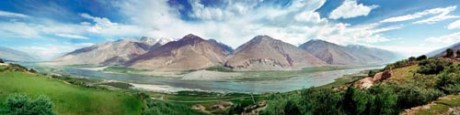
Yesterday I listened to Arthur Zajonc speak about the importance of sustaining contradiction in order to cultivate a deep epistemology of mind. Zajonc, professor of physics at Amherst College and scientific coordinator for the Mind and Life dialogue with H.H. the Dalai Lama, pointed out to our faculty group who had gathered for a contemplative pedagogy conference, that we must be able to sustain contradictions for ourselves and our students if we are to have a fresh experience of an object or a phenomenon. Physicists, he said, live with the wave-particle duality while mathematicians embrace the point at infinity.
Here I add to his list of sustained contradictions in the sciences a contribution from my own discipline, geology. As Arthur spoke, I saw the peaks of the Karakoram range in Northern Pakistan, a rugged landscape near Nanga Parbat that I helped map in 1990. This dynamic region at the confluence of the Pamir, Karakoram, Hindu Kush and Himalyan ranges—known as the roof of the world—is both rising up and wearing down simultaneously. Geologists study this spectacular orogen, created by the collision between the Asian and Indian lithospheric plates beginning 60 millions years ago, in order to examine questions such as how does continental lithosphere form? How are continents assembled? How are they reworked and deformed? Breathing laboriously at the highest altitudes on earth while stepping gingerly over unstable talus slopes, geologists doing the field work physically sustain contradictions.
Omega Institute Makes “Wastewater” an Oxymoron July 22, 2009
Posted by Jill S. Schneiderman in contemplative practice, hydrologic cycle.add a comment
This is cross-posted at Shambhala SunSpace.
Omega Institute’s Earth Dharma
By Jill S. Schneiderman
Department of Earth Science and Geography
Vassar College

Yesterday I went to the opening ceremony and ribbon cutting at the Omega Institute’s new Center for Sustainable Living (OCSL). Omega calls the Center a “Living Building,” an “Eco-Machine.” Essentially a wastewater treatment facility for the five million gallons of wastewater generated on the Omega campus each year, the Eco-Machine “closes the loop” on water use at Omega. Designed with the Hudson Valley’s ecological characteristics in mind, this building that is incidentally just up the Hudson River from Poughkeepsie, site of the nation’s first water filtration plant, produces all its own energy with renewable resources and captures and treats all its water.
As a result of the project, waste flushed down toilets on the Omega Campus flows into septic tanks where microbes begin to decompose it anaerobically (in the absence of oxygen). Then, water is pumped through two constructed “wetlands” where plants metabolize the waste and into two aerated ‘lagoons’ in a greenhouse, where plant roots suspended in the water provide surface area for bacteria to break down additional nutrients. Finally, the clarified water circulates through a sandy filter field where particulate matter and any remaining nutrients settle out. Single-celled and multicellular organisms including algae, fungi, bacteria, protozoans, zooplankton, invertebrates (e.g. snails) and vertebrates (e.g. fish) representing all the major groups of life are present in the Eco-Machine. The processed water is currently dispersed into groundwater but eventually will be reused to flush toilets and irrigate gardens.
OCSL’s Eco-Machine is remarkable, not only for closing the loop on water usage at Omega, but for producing all its own energy, controlling building temperature geothermally, utilizing solar and photovoltaic power, and collecting and utilizing rainwater. Additionally, it was built with materials made within a limited distance from the structure itself. Omega intends for it to be certified as the first “Living Building” in the United States. Regardless of whether the building achieves that official status, Omega’s construction project is not only consistent with the institute’s orientation towards holistic and sustainable living; it is a model for the present and future.
As a contemplative earth scientist, I love that Omega refers to its facility as an Eco-Machine. James Hutton, the 18th century Scottish physician and gentleman farmer, considered the founder of geology, derived a principle of an endlessly cycling “World Machine” and used it along with his belief in the existence of a benevolent God, to convince thinkers of his day that the Earth was ancient-millions of years old. The “paradox of the soil, ” he said, was that in order to sustain life, soil depleted by farming must have a mechanism to refresh itself, replenish depleted nutrients, and survive to grow crops once again. This cycle, he knew, would take time. And to his mind, a benevolent God would never craft an earth that did not have a mechanism by which to recycle itself. A closed loop of soil recycling, would take vast amounts of time-hence an ancient Earth-and would be an eternally cycling world machine that would forever sustain every living being. In Hutton’s most famous words the earth shows, “no vestige of a beginning, — no prospect of an end.” (Theory of the Earth, 1788, 304).
In his remarks at the OCSL’s opening, Robert ‘Skip’ Backus, the person who vision and effort helped bring the project to fruition spoke of the oxymoronic phrase ‘wastewater.’ Indeed, there is no such entity as wastewater and an understanding of another of the Earth System’s cycles, the hydrologic cycle, reveals this to be true.
In a continual cycle of condensation, precipitation, runoff, surface flow infiltration, subsurface flow, and evaporation, water circulates on and through the Earth-it is the original closed loop. Leaders at the Omega Institute have skillfully listened to the Earth and acted on what I like to think of as Earth Dharma-fundamental principles that show the path to right action in terms of abstaining from taking what is not given. Earth Dharma reveals how we, as one minute portion of the Earth System, should behave in light of our status as small but strong component of that System. I see Earth Dharma as a corollary to the first line of the Metta Sutra: “This is what should be done by all those who are skilled in goodness, and who know the path of peace.” The Earth is a storehouse of lessons consonant with the Buddha’s teachings. So it seems fitting to me that Omega has stepped forward once again to lead people in the direction of mindful living on Earth.
Jill S. Schneiderman is Professor of Earth Science at Vassar College. This year she received a Contemplative Practice Fellowship from the Center for Contemplative Mind in Society. She is editor of and contributor to For the Rock Record: Geologists on Intelligent Design (University of California Press, 2009) and The Earth Around Us: Maintaining a Livable Planet (Westview Press, 2003).
Learn more about Omega’s Center for Sustainable Living here.
Another Reason Why I Don’t Keep a Gun in the House February 23, 2009
Posted by Jill S. Schneiderman in contemplative practice, poetry.add a comment
The neighbors’ dog will not stop barking.
He is barking the same high, rhythmic bark
That he barks every time they leave the house.
They must switch him on on their way out.
The neighbors’ dog will not stop barking.
I close all the windows in the house
And put on a Beethoven symphony full blast
But I can still hear him muffled under the music,
barking, barking, barking,
and now I can see him sitting in the orchestra,
his head raised confidently as if Beethoven
had included a part for barking dog.
When the record finally ends he is still barking,
sitting there in the oboe section barking,
his eyes fixed on the conductor who is
entreating him with his baton
while the other musicians listen in respectful
silence to the famous barking dog solo,
that endless coda that first established
Beethoven as an innovative genius.
billy collins: complete resource for Billy Collins poems, books, recordings
Sylvia Boorstein, meditation teacher, psychotherapist, and storyteller, read this poem in a recent dharma talk. I like it because it speaks to the creativity that can arise unexpectedly from what might otherwise be experienced as annoyances.
 earthdharma.org