“Live Streaming” Oil and Video May 30, 2010
Posted by Jill S. Schneiderman in BP/Deepwater Horizon oil catastrophe, Buddhist concepts, oil, oil spill.add a comment

BP has officially declared that its operation “Top Kill” has been a failure. Of course I wish it hadn’t failed even though I dislike the phrase– “top kill”– used to describe the sadly comical ‘operation’. The experts disingenuously choose words that they hope will convey to onlookers some degree of confidence while the professionals dump old tires, golf balls, and mud into the hole to plug the leak.
I’m unsurprised completely that “top kill” has failed. Try to plug an open fire hydrant with the palm of your hand and simulate the challenge the fixer-uppers face.
It’s difficult to feel anything other than despair. Buddhist thinkers would tell us at least to pay attention. My advice? Don’t be distracted from concentrating on this reality by obscure terminology and political spin. Monitor the source of the disaster by watching here the live streaming video of the plume of oil gushing from the site of the BP/Transocean calamity and the Remotely Operated Vehicle (ROV) attempt to stop the flow.
The Earth Day BP Oil Catastrophe: When Do We Say “Dayenu” (Enough)? May 14, 2010
Posted by Jill S. Schneiderman in Barbados, BP/Deepwater Horizon oil catastrophe, Buddhist concepts, disasters, earth community, fossil fuel, oil, oil spill.add a comment
This piece is cross-posted at Shambhala SunSpace.

“What counts is not the enormity of the task, but the size of the courage,” says Matthieu Ricard, a Buddhist monk and confidant of the Dalai Lama who was dubbed “Mr. Happy” after U.S. neuroscientists declared him the most content man they ever tested. Ricard’s statement resonated for me in light of continued developments in what I’ve come to think of as the Earth Day BP Oil Catastrophe. We’re going to need this kind of inspiration in order to deal with the Gulf of Mexico mess because the magnitude of the task before us—stopping the forcefully gushing oil, cleaning up devastated habitat, caring for injured or soon-to-be-harmed living beings in the path of the petroleum, protecting as yet unaffected regions—boggles the mind as it stirs the heart.
Since I’ve just returned from a weeklong Jewish Mindfulness Meditation Teacher Training retreat, I’ve been away from the news of this calamity. But sad to say, my geologist’s perspective leaves me unsurprised by broadcasts of impotent efforts of oil industry professionals to handle the tragedy. Why? Because I’ve been sitting for the last week paying attention to body sensations, I’ll just say that we earth scientists feel in our guts the vast scales of Earth time and space; (it’s why I write about them). As Congress and a federal panel in Louisiana begin their inquiry into the situation not one person should be perplexed by the sequence of events that follow the explosion and sinking of the Deepwater Horizon oilrig. Here’s why.
First of all, this event is much more than just another “oil spill.” To me, the word spill suggests flow from a confined space and implies a finite amount of liquid. The monster in the Gulf of Mexico is a gusher, a blowout, an uncontrolled flow of oil from a well bored into the earth, what drillers call a “wild well.” Dr. Frankenstein has put a spigot in the Earth and can’t shut it off.
When in September 2009 BP announced its discovery of the Tiber oilfield—what the workers on the Deepwater Horizon were boring into when it exploded—they characterized it as “giant” and meant to convey that their find contained between four and six billion barrels of oil; this contrasts with a “huge” oilfield usually considered to contain 250 million barrels of the stuff. Regardless of whether it’s giant or huge, this Gulf of Mexico event is more than a spill. Basically we’ve tapped into a source of oil that will not be exhausted quickly. Isn’t that ironic?
It’s impossible to conceptualize such vast quantities, and as the crude oil continues to spew for the 24th consecutive day at daily rates reported to be 210,000 gallons, I’d like to help. Check out a Google Earth map website by Paul Rademacher that will allow you to compare the horizontal extent of the oil with the geographic size of your city, county or state. I checked Barbados, the tiny island on which I currently live; the crude oil would blanket it completely.

Ditto my home county—Dutchess in New York. It’s way bigger than Rhode Island, our convenient measuring rod for environmental disaster (Remember the Larsen Ice Shelf? The 220 meter thick—three football fields—chunk of ice “the size of Rhode Island” that disintegrated in 2002 after having been stable for up to 12,000 years.) Check the places that matter most to you and sense in your gut the feeling caused by the spatial comparison.
And speaking of space, oil and gas executives crowed about their record-setting achievement, touting it as one of the deepest wells ever achieved by their industry—drilled 35,055 feet deep into the Earth’s crust beneath 4,132 feet of water. You may wonder, “Just how deep into the earth is that?” Let’s put it this way, transcontinental flights cruise at that elevation above the Earth’s surface. Next time you are in an airplane, picture a pipe connecting your jet to the surface of the Earth and you’ll have a picture of the distance that BP went to access the Tiber Oilfield black gold.
Would that these innovators had gone to such extremes in order to apply to their work an ethical code that includes the Precautionary Principle:
“When an activity raises threats of harm to the environment or human health, precautionary measures should be taken even if some cause and effect relationships are not fully established scientifically.”
Regrettably, precautionary action has been the exception rather than the rule in U.S. environmental policy. Perhaps it has operated to the frustration of some in decisions concerning disposal of high-level radioactive waste at Yucca Mountain, but the Earth Day BP Oil Catastrophe demonstrates the virtue of Vorsorgeprinzip, German for “precautionary principle.” Literally, Vorsorge means “forecaring” and conveys forethought and preparedness—not simply “caution.” I say that a plan to bore “the deepest well ever” into the Earth, should be accompanied by accurately scaled and well-tested models for responding to unexpected contingencies. Ahimsa, first do no harm.
The first homework assignment of my Jewish Mindfulness Teacher Training program was to read Jack Kornfield on the five basic Buddhist training precepts. Number two, “we undertake the precept of refraining from taking that which is not given,” strikes me as particularly apt given the circumstances in the Gulf. We consent to not take that which does not belong to us. We agree to bring consciousness to the use of all of the earth’s resources in a respectful and ecological way.
When will we, like Job, clap our hands to our mouths with the realization that human beings occupy an infinitesimal place within a divine whole? When will the “knowledge” of modernity succumb to the wisdom of the ancients? Could the answer to Job’s question of how long must his people suffer, “Till towns lie waste without inhabitants, and houses without people; and the ground lies waste and desolate (Isaiah 6:11),” be also the answer to the question, when will the oil stop gushing? The chutzpah of humans got us into this mess; humility will help us out of it. We will need clear mind, wise heart, and sizable courage to say dayenu, enough.
Click here for more of Jill S. Schneiderman’s Earth Dharma posts.


Trackbacks are closed, but you can post a comment.
‘Eaarth’ Gay on ‘Eaarth’ Day 2010 April 22, 2010
Posted by Jill S. Schneiderman in 'Eaarth' Day, Buddhist concepts, climate change, contemplative practice, earth community, environmental justice, LGBT concerns, Vassar College.5 comments

Sometimes I feel blasé about Earth Day because I grow tired of talk without action. As a bujugeoscientist (that’s a Buddhist, Jewish, geoscientist) I’m inclined towards Right Speech and Right Action among the steps of the eightfold-path. As a result, I am unmoved by the verbiage of Earth Day.
Founded with good intentions by Senator Gaylord Nelson forty years ago today, it was designed as an environmental “teach-in” to inspire awareness and appreciation for the Earth’s environment. But I think it’s time for the speechifying (and partying that sometimes goes with it) to be supplanted by serious (right) action.
So, I’m pleased to share my delight today at having stumbled upon a new organization, OUT for Sustainability that aims to engage and mobilize the LGBT community around progressive environmental thinking. In my opinion, environmentalists like those running Earth Day events can learn plenty from LGBT activists who have had to mobilize swiftly to fight life-threatening illness and counter gross civil rights injustices.
The current state of Eaarth should move Eaarthlings as the AIDS-crisis moved LGBT activists. Started in 2009, OUT for Sustainability seems to me to represent the type of alliances this planet and its living beings need now. My queer Vassar College students get this connection; for example, they are OUT working on advanced degrees in epidemiology and environmental science; serving as educators about climate change; directing films about the effects of Hurricane Katrina; and promoting organizations that focus on issues of environmental justice, including food justice and health.
Thank you students! Thank you OUT for Sustainability. On Eaarth Day 2010, this Eaarth Gay feels inspired.
Awaken, Eaarthlings! An Earth Day Missive April 22, 2010
Posted by Jill S. Schneiderman in "Eaarth", Anthropocene, Bill McKibben, book review, Buddhist concepts, climate change, earth community, earth cycles, geologic time, Thich Nhat Hanh.add a comment
This piece is cross-posted at Shambhala SunSpace, CommonDreams.org, and Truthout.

In his recent book, The World We Have: A Buddhist Approach to Peace and Ecology (2008), the great Buddhist teacher Thich Nhat Hanh asserts that Buddhism, as a robust type of humanism, allows people to learn how to live on our planet not only responsibly, but with compassion and lovingkindness. Every Buddhist practitioner, he says, should have the capacity to “protect” the environment and determine the destiny of the Earth.
Though I would argue that we have moved beyond the point at which the planet can be protected and that we must join with Earth as kin, Thich Nhat Hanh contends that if we awaken to the environmental reality of our planetary circumstance, our collective consciousness will shift. He declares that Buddhists must help rouse people on Earth, stating “We have to help the Buddha to wake up the people who are living in a dream.”
Bill McKibben, author of more than a dozen books including The End of Nature (1989), perhaps the first book for the layperson about climate change, and founder of 350.org, a global warming awareness campaign that coordinated what CNN called “the most widespread day of political action in the planet’s history,” has devoted much energy to this project of awakening. McKibben may not be a Buddhist, but his interview with Krista Tippett, host of American Public Radio’s Speaking of Faith, reveals him to be a spiritual thinker. His most recent effort to bring about this tectonic shift in the collective human mind and heart is his book Eaarth: Making a Life on a Tough New Planet.
McKibben argues that humans have changed Earth in such fundamental ways that it is no longer the planet on which human civilization developed over the past 10,000 years. Seawater is becoming acidic as oceans absorb carbon from the atmosphere; the cryosphere—Earth’s once frozen realms of ice caps and high mountain glaciers—has melted or is in the process of doing so; tropical regions of the globe have pushed two degrees further north and south changing patterns of rainfall and causing droughts, fires and floods.
What’s more, these geographically vast features are changing rapidly. As I tell my students, we humans have acted as geologic agents at non-geologic time scales. McKibben’s central point is a corollary to this formulation: global change is no longer a threat, a changed globe is our reality. Hence, McKibben’s homophone: we live on Eaarth, not Earth. His book is the call to stir that Thich Nhat Hanh prescribes. In the service of helping to rally the populace to such awareness, I’d like to add some Buddhist geoscience to McKibben’s already excellent reality check.
The Buddha spoke of the impermanence of things and in The World We Have, Thich Nhat Hanh reminds us that the sixth-century Greek philosopher, Heraclitus said that because a river changes constantly, we never step into the same river twice. Hanh writes, “Nothing stays the same for two consecutive moments. A view that is not based on impermanence is a wrong view. When we have the insight of impermanence, we suffer less and we create more happiness.” According to Thich Nhat Hanh, people resist two types of impermanence: instantaneous and cyclic. Using the analogy of water set to boil, he teaches that the increase in water temperature from moment to moment manifests instantaneous impermanence. However, when the water boils and turns to steam, we witness cyclic impermanence—the end of a cycle of arising, duration and cessation.
Thich Nhat Hahn suggests that we must look deeply at cyclic change in order to accept it as an integral aspect of life and as a result, not startle or suffer so greatly when we endure shifts in circumstances. Looking deeply at cyclic change—for example the transformation of rocks to soil and back again—is what we geoscientists do. We gaze deeply at impermanence and know that without it, life would not be possible.
McKibben avers that we have passed the geological moment when we might possibly have avoided the mutation from Earth to Eaarth. Though he doesn’t name it as such, we have moved from The Holocene Epoch—the most recent 12,000 years since the Earth emerged from the last major ice age—into what Paul Crutzen, the Nobel Prize-winning chemist called the Anthropocene—a new geological epoch denoted by novel biotic, geochemical, and sedimentary effects of global proportion induced by human activity. To a Buddhist geoscientist such as I, this formulation of our current planetary predicament makes deep sense. In order to understand why, I must mention a few monumental concepts in Earth history, namely evolution, punctuated equilibrium, and extinction. Impossible a task as it is to explain such big topics, since we humans seem to excel at taking in more than we can digest, I’ll give it a try.
Evolution—commonly misrepresented as improvement or progress—is, quite simply, change. Most familiarly, species evolve; they do so by punctuated equilibrium, a fancy phrase that means that organisms mostly stay the same but when they do change, they do so quickly and in spurts of geological time. Or they die.
Which brings us to extinction events. The geological record is replete with them, their intensity ranges from the small and local to the massive and global—the ones that shattered Earth’s biological order. Like the episode 65 million years ago that famously wiped out dinosaurs as well as numerous other species across the spectrum of life in all habitats sampled from the fossil record. Seventeen percent of families (the taxonomic unit above genus and species, a family can consist of a few to thousands of species) were lost in that extinction event. Or the greatest mass extinction as yet, the one 245 million years ago that marks the end of the Paleozoic Era; it rid the Earth of trilobites, those early marine invertebrates with a segmented body and exoskeleton that belong to the same group (Phylum Arthropoda) as modern-day crabs, insects and spiders as well as fifty-four percent of all living families.
These and other mass extinction events happened concurrently with vast climatic and physical disturbances on Earth that were outside the norm of what species and ecosystems ordinarily survived. Such extreme physical changes doubtless had something to do with the occurrence of the extinctions in the first place. Lest I embark on a far-reaching lesson in Earth history, I’ll make the point simply, that over geological time life on the planet and Earth itself have morphed from one form to another. Our seas were acidic in the Archean and our atmosphere was oxygen-poor in the early Proterozoic (“age of first life”). This is the way I see our situation: all beings now live on Eaarth during the Anthropocene. Like other organisms before us we are challenged by changed environmental circumstances and must adjust to Eaarth in its current state.
To this Buddhist geoscientist the planet and its life forms epitomize impermanence. When I read the history of our planet I can’t help but see it as fitting with the concept of cyclic impermanence in particular. I ask, how will the species homo sapiens fare as we make our way across the epochs from Holocene to Anthropocene? Will humans and other great apes be counted among the taxonomic families that succumb in this latest great extinction? Will the record of our one-time presence on the planet comprise only an early Anthropocene stratum of bones, tools and garbage? Both McKibben and Thich Nhat Hanh give us reason to believe that human beings, if we wake up in the Anthropocene on Eaarth, instead may persist as one of the long-lived multicellular species on the planet (think horseshoe crab).
In the second part of Eaarth, McKibben argues that the catalyst for the evolution of Earth to Eaarth has been insatiable, fast growth. He says that any hope for our future on Eaarth depends on “scaling back” and “hunkering down”—creating communities that concentrate on the essentials of maintenance rather than the spoils of growth. He provides inspirational examples of neighborhood windmills, provincial currencies, corner markets, and local internet communities. Thich Nhat Hanh does the same, describing the efforts of his Sangha to practice mindful consumption. Both visionaries advocate proximal, small-scale ways of living.
By looking back in Earth history as we geologists do, I’d like to support with geological evidence the soundness of McKibben’s and Thich Nhat Hanh’s approach to surviving on Eaarth. The Earth’s most successful and abundant life forms are prokaryotes (organisms that lack a cell nucleus or any other membrane-bound organelles). They appear as fossils in 3.5 billion year old rocks and persist today in nearly all environments where liquid water exists. Some thrive in harsh regions like the snow surface of Antarctica while others persist at marine hydrothermal vents and land-based hot springs. Some use photosynthesis and organic compounds for energy while others obtain energy from inorganic compounds such as hydrogen sulfide.
Prokaryotes keep things pretty simple and make do with what exists in their immediate surroundings. Lots of them live together. They’ve survived numerous extinction events. Can it be that the collective simplicity they represent suggests a way forward for awakened Eaarthlings?
For more “Earth Dharma” from Jill S. Schneiderman, click here.
See also our Shambhala Sun Spotlight on Buddhism and Green Living.
Trackbacks are closed, but you can post a comment.
Adventures with Wind on Water March 20, 2010
Posted by Jill S. Schneiderman in Barbados, book review, Buddhist concepts, earth cycles, geology, learning differences.2 comments
This piece is cross-posted at Shambhala SunSpace.
Earth Dharma: “Planned Outage”
 Yesterday I stepped onto the volcanic terra firma of St. Vincent, though I hesitate to call it that given the spate of earthquakes in the first quarter of 2010, after having sailed down the Grenadine islands with my partner, our two kids, and their grandparents. Chris, the skipper of our Barefoot Charter, was a forty-something nice guy who had recently checked out of Washington (state), left behind television, telephone, and internet connection, to follow his dream of skippering sailboats in the Caribbean Sea. When I saw that the name of our fifty-foot monohull was Planned Outage and glimpsed Chris reading The Art of Happiness by H.H. The Dalai Lama, I felt delighted about the experience we were about to have.
The book I’d taken with me on the three-day sail was Saltwater Buddha, Jaimal Yogis’ memoir about learning the lessons of Zen Buddhism while living a surfer’s life. I have to admit that after reading a brief excerpt I didn’t see immediately the appeal of the book. I thought to myself, “What is this guy going to teach me about lessons learned along a meandering course of thrill seeking?” I’d done my own share of thrill seeking and meditating and I’ve lived a lot longer than Yogis, encountering my own piece of disillusionment. But as Charles Darwin surely thought about James Hutton’s Theory of the Earth, his choice of reading material aboard the Beagle, “this book is great!”
I didn’t know Yogis’ tale and had no idea he ended up at the Columbia School of Journalism but I wasn’t surprised to find that out because Saltwater Buddha is a good story. From California to Hawaii to France, India, Brooklyn and finally back again, with richly described characters like a sagacious Hawaiian insurance agent immobilized by Elephant Man disease, leather-skinned commercial fishermen in dock-side bars in Montauk, red rubber-suited Santa Cruz “Surf Nazis”, and a hilarious caricature of Yogis as a bliss-seeking surf bum who gets closest to having a real job when as a barista in San Francisco he gets “really good at making the thick foam with the little leafy designs,” Yogis shows his readers how lessons of dharma abound in life experiences that range from the mundane—caring for a sick friend—to the absurd—surfing in a snowstorm in Brooklyn.
I was attracted to the book because I’m living seaside, having run away from professional responsibility with my family at the age of 50, so that we all could recover from the two-year ordeal of dealing with schools, psychologists, doctors and lawyers while negotiating the rough surf that’s called education for kids with learning differences in the U.S. Not to mention the exposure of our difference as a family with queer parents. I’ve been seeking the healing balm of the sea spray myself—an escape from the samsara caused by narrow conceptions of intelligence—meditating daily and interspersing my days and those of my kids with windsurfing and sailing. My whole family has taken to living in the present, and the blue waters surrounding this chunk of coral in the eastern Caribbean have certainly helped. As my friends say, it’s been a skillful move.
What I loved about Saltwater Buddha is the way Yogis easily accesses earth dharma. His observations about wind and water resonated for me as a geoscientist who alternates periods of sitting and adventures with wind on water. For example, Yogis describes the earth science related to surfing: creation of tides as the moon tugs at the ocean; materialization of waves as water feels the seafloor on its coastal approach; and, formation of wind owing to temperature differences between land and sea. Yogis sees the poetry of the earth system.
Of the four spheres of the earth system—rock sphere, biosphere, atmosphere and hydrosphere—the latter two, as fluids, are especially available to sentient beings as dharma teachers because they move and change in time frames quick enough for us to perceive them. Living this year at the edge of the sea, I walk daily along the shore and watch the fluctuating character of the air and water. When previously I’d been for short periods to places where I’d hoped for placid seas, it always seemed that my timing was off—according to the locals the sea was calmer or the wind more gentle just before I’d arrived. But living at the waters edge this year, I see that the ocean—the biggest reservoir of the hydrosphere— and the atmosphere change constantly. They manifest fluidity.
In Saltwater Buddha, Yogis quotes Suzuki Roshi: “waves are the practice of water. To speak of waves apart from water or water apart from waves, is delusion.” My shore walks reveal that we can say the same for the atmosphere; wind is the habit of air and to speak of the two apart from one another is fantasy. The ways of water and air bring home the Buddha’s fundamental teaching of impermanence. As Yogis recognized, each different face of the sea offers episodes of samsara and nirvana. Lately Caribbean breezes have taught me lessons that Brooklyn surf taught Yogis.
Huge swells and shifting winds have caused me to be caught up “in irons” on my dinghy and capsized in a mooring field; but I’ve also had the chance to ride winds on a beam reach while hawksbill turtles lift their heads for subaerial breaths above teal blue waters. As the surfer merges with his medium, so the sailor melds with hers. Connecting with our surroundings in these ways fosters the natural inclination to live with harmony on Earth.
Too, both pastimes are good metaphors for life. Since environmental conditions are mutable, attachment to any one set of circumstances causes suffering. Yogis’ book in combination with my Caribbean sailing adventures reminds me of a slogan on the door of the West End Racing Club in Provincetown, Massachusetts: “You can’t direct the wind but you can adjust the sails.” Or, as my dyslexic sailing instructor cautions, “you can only sail where the wind will let you.”
Read-aloud sessions are my family’s book habit. These past three days aboard Planned Outage we listened to sections of Saltwater Buddha. As sharp-eared dyslexics, my kids recognized a good story. They said they’d like to see the movie and were delighted to learn that the visual version is in production. No doubt we’ll all relish seeing the film when it’s released, but for the time being, we’re living Yogis’ lessons together in the present.
For more “Earth Dharma” from Jill S. Schneiderman, click here.
See also:
- Saltwater Buddha: the film
- An exclusive excerpt from Saltwater Buddha
- Losing Everything Can Mean Finally Beginning
- So Sad, No Problem: Roaming India after a painful breakup, Jaimal Yogis befriends a monk who teaches him an unexpected lesson about happiness.
- What’s happened to Sonam? Jaimal Yogis follows up on his spiritual friend.
This entry was created by Jill S. Schneiderman, posted on March 19, 2010 at 8:58 pm and tagged Books, Environment, Science, Zen. Bookmark the permalink. Follow any comments here with the RSS feed for this post.
Chile, Haiti, and “Govinda’s Bridge” March 4, 2010
Posted by Jill S. Schneiderman in Andes, Buddhist concepts, Chile, disasters, earth community, earth cycles, earthquakes, environmental justice, geology, Haiti.3 comments
This piece is cross-posted at Shambhala SunSpace.

When I turned as part of my daily practice to today’s page of Offerings, a compilation of Buddhist quotations, I read a comment by Lama Anagarika Govinda that registered as particularly meaningful in light of the recent earthquake in Chile:
“A bridge is revealed which connects the everyday world of sense perceptions to the realm of timeless knowledge.”
Oddly enough, given the topic of collapsed infrastructure as a result of recent high magnitude earthquakes in Haiti and Chile, a visible viaduct has emerged which connects the agonizing reality of these events to the timeless truth that economically and educationally impoverished people are disproportionately vulnerable to risks posed by life on a dynamic planet.
How is it that these two seismic events in the first quarter of 2010 have together exposed Govinda’s bridge?
In order to answer that question we must compare geologically these natural events. Both earthquakes occurred at lithospheric plate boundaries. Geologists have come to expect earthquakes at these locations because such boundaries, which are delineated by earthquakes and often volcanism, are the relatively flexible seams that connect pieces of comparatively inflexible crust comprising the skin of the earth. When rigid crust moves, it releases energy stored in the rocks causing them to break abruptly. This is a fundamental geological reality that all human beings must understand, as a starting point, if we are to lessen the catastrophic human consequences that follow from such natural events. Both temblors were massive — Chile magnitude 8.8 , Haiti 7.0. In fact, the Chilean event ranks among the largest quakes ever measured.
A substantial geological difference between the Chile and Haiti tremors was that the former originated deep in the Earth’s crust, 35 km, while the latter one had a shallow focus, 13 km. The difference in the depth of the rupture relates to the type of plate boundary at each site — sideways sliding in Haiti versus downward thrust in Chile. And though to the geologically uninitiated the difference between 8.8 and 7.0 may seem negligible, the Richter scale is logarithmic, not linear, and that means that the Chilean quake was substantially stronger than the Haitian one. These geological details beg the human question, why do the numbers of Haitian deaths and catastrophic injuries eclipse Chilean ones?
The answer to the question has socioeconomic, rather than geologic roots. An adage well known to geologists reads, “Earthquakes don’t kill people, buildings do.” Many Chileans were spared crush-injuries and death because Chile constructed quake-resistant buildings after experiencing a 9.5 magnitude earthquake in 1960. In this recent event, buildings shook but did not collapse into stacks of flattened concrete, minimizing the chance that Chileans might be killed or trapped inside them. Too, the Chilean quake struck near Concepcion, a region of much lower population than Port-au-Prince.
We can build earthquake-resistant structures with adequate know-how and financial resources. Concrete, a common and relatively strong masonry material consists of cement — primarily heated limestone that is finely ground and mixed with the mineral gypsum—that binds together sand and gravel. But concrete doesn’t stretch or extend very well when stressed by shearing horizontal forces. It can be reinforced with steel bars or pre-stressed for use as an earthquake-resistant building material. Other elements of an earthquake resistant building include a good-quality foundation and high quality cement.
Living on land prone to shift, Chileans endure constant reminders of the need to utilize high quality building materials and enforce strict building regulations. Haitians also receive portentous jolts. But Chile, not Haiti, is one of the most earthquake-ready countries in South America, Central America and the Caribbean. Why are buildings in Chile more stable than those in Haiti? While 98% of Chileans are literate and 18% of the population lives in poverty, the respective numbers for Haiti are 53% and 80%. These numbers may explain why Haitians have used brittle steel without ribbing and poor quality cement to hold together concrete. And using cement too sparingly for mortar between concrete blocks or in the production of the concrete itself reduces the earthquake resistance of the structure built with it. In Haiti inferior building materials and poor building practices have been replicated from the foundation up. As a result, the Haitian earthquake left more than 200,000 people dead, nearly one million people homeless, and an indeterminate amount of pain and anguish; in Chile we may hope that the death toll will not reach four digits.
When we examine a geologic map of the world, an unfortunate reality becomes clear: the earth’s most populous cities exist along plate boundaries. Plate boundaries coincide with shorelines and sources of water hence our earliest civilizations arose there and grew to be villages and towns. Today large population centers in places like Tehran and Istanbul are disasters waiting to happen. Though geologists cannot predict when an earthquake will occur, we can forecast, in decades-wide windows, the inevitability of such events. Haphazardly constructed communities in vulnerable mega-cities put millions of people at risk for the suffering that ensues after a large earthquake in a poorly prepared region. The Buddha taught that suffering is endless yet one must vow to end it. Anyone who subscribes to this principle must reject as unacceptable the disproportionate vulnerability of the poor and under-educated to the earth’s perpetual processes.
Buddhist Survival in the Andes February 5, 2010
Posted by Jill S. Schneiderman in Andes, book review, Buddhist concepts.add a comment
This piece is cross-posted at Shambhala SunSpace.
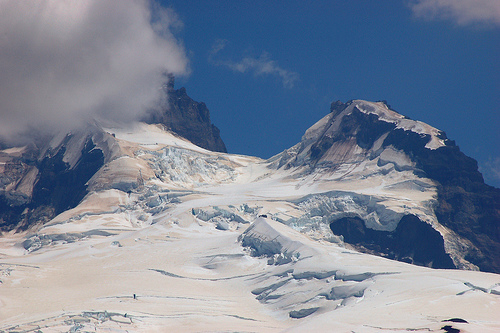
 I just finished reading Nando Parrado’s account of his 72-day ordeal of pain and suffering in the South American cordillera, Miracle in the Andes (2006). It’s an extraordinary testimony of his survival, along with 15 out of 45 people, most of them rugby teammates, after their privately chartered airplane crashes into the side of a volcano en route from Montevideo, Uruguay to San Fernando, Chile and comes to rest on a glacier at nearly 12,000 feet above sea level. Instead of having these members of the Old Christians rugby team play an exhibition game in Chile, the boys—most of them no more than 23 years old—find themselves relying on each other and their most intimate interior selves as they struggle to survive after the Argentine, Uruguayan and Chilean rescue teams have given up the search. Parrado’s observations about the exterior landscape in which he survives impressed me as a geologist. Even more amazing however were his remarks about the interior landscape of survival because to me they resonated with Buddhist thinking about living with suffering.
I’d read Alive (1975), Piers Paul Read’s gruesome and sensational tale of this disaster replete with charges of cannibalism and ostensibly heroic feats, as a high school student in the late seventies; as much as I can remember, it bears little resemblance to the book I just read. In this book, Parrado details the mountainous landscape that hosts the plane’s fuselage including notes about the appearance of glacial ice, volcanic rocks, sedimentary strata, skin-shredding talus slopes, and house-sized boulders reposing in braided streams. Even more noteworthy is his deep appreciation of the Earth’s vast scales of geologic time. Parrado writes: “I felt an involuntary sense of privilege and gratitude, as humans often do when treated to one of nature’s wonders, but it lasted only a moment. After my education on the mountain, I understood that all this beauty was not for me. The Andes had staged this spectacle for millions of years, long before humans even walked the earth, and it would continue to do so after all of us were gone” (203). Parrado has the eye of a naturalist. Benefiting from the gift of time more than 30 years after his hardship he describes with poetic accuracy this remote, inaccessible high-reaching cordillera, a terrain that most people will never encounter.
Parrado’s description of this trek to salvation on his own behalf, as well as that of other survivors, hints at the truly remarkable interior landscape to which his trial allowed access:
On the morning of December 8, the seventh day of our trek, the punishing snow cover began to give way to scattered patches of gray ice and fields of sharp loose rubble. I was weakening rapidly. Each step now required supreme effort, and a total concentration of my will. My mind had narrowed until there was no room in my consciousness for anything but my next stride, the careful placement of a foot, the critical issue of moving forward….
I would feel an apprehension of the age and experience of the mountains, and realize that they had stood here silent and oblivious, as civilizations rose and fell. Against the backdrop of the Andes, it was impossible to ignore the fact that human life was just a tiny blip in time, and I knew that if the mountains had minds, our lives would pass too quickly for them to notice. It struck me, though, that even the mountains were not eternal. If the earth lasts long enough, all these peaks will someday crumble to dust. So what is the significance of a single human life? Why do we struggle? Why do we endure such suffering and pain? What keeps us battling so desperately to live, when we could simply surrender, sink into the silence in the shadows, and know peace? (212-213)
Parrado’s depiction of his interior journey resonates with Buddhist approaches to a life of suffering. Central to Parrado’s ability to survive was his emphasis on breathing. More than once he recounts how his reminder to focus on the breath was the key to his survival. He writes:
I drew a long breath and then slowly, richly, I exhaled. Breathe once more, we used to say on the mountain, to encourage each other in moments of despair. As long as you breathe, you are alive. In those days, each breath was almost an act of defiance… Again and again, I filled my lungs, then let the air out in long, unhurried exhalations, and with each breath I whispered to myself in amazement: I am alive. I am alive. I am alive. (233)
What’s more, Parrado exhorted himself to pay attention for he saw that ability as life-saving. In puzzling over whether his survival was an act of God or of self-reliance he wrote:
It was not a God who would choose to save us or abandon us, or change [us] in any way. It was simply a silence, a wholeness, an awe-inspiring simplicity. It seemed to reach me through my own feelings of love and I have often thought that when we feel what we call love, we are really feeling our connection to this awesome presence. I feel this presence still when my mind quiets and I really pay attention. (263)
Parrado described how, by being present for every step and every breath, he was able to survive each moment of pain, loss, and suffering: “These moments bring time to a stop for me. I savor them and let each one become a miniature eternity, and by living the small moments of my life so fully, I defy the shadow of death that hovers over all of us, I reaffirm my love and gratitude for all the gifts I’ve been given, and I feel myself more and more deeply with life.” (262) Though Parrado gives no indication that he studied Buddhist teachings, he sounds as if before the crash he’d been meditating for years. He tells his readers that something in the mountains wanted him to be still: “I gazed at this place: we had upset an ancient balance, and balance would have to be restored. It was all around me, in the silence, in the cold. Something wanted all that perfect silence back again; something in the mountain wanted us to be still.” (188)
In these trying times that to some may feel as difficult as survival in the high Andes, Parrado offers well-tested advice—breathe, pay attention, be still.
For more “Earth Dharma” from Jill S. Schneiderman, click here.
Trackbacks are closed, but you can post a comment.
Edwidge Danticat on Haiti Earthquake Devastation January 29, 2010
Posted by Jill S. Schneiderman in Buddhist concepts, Haiti.add a comment
 In Brother, I’m Dying, writer Edwidge Danticat retold the heartbreaking story of her Uncle Joseph’s detention and death, and his son Maxo’s attempt to save him. Danticat has a piece in the Comment section of this week’s New Yorker, “A Little While,” in which she pays tribute to her cousin Maxo who died after being crushed beneath a building that fell during the Port-au-Prince earthquake.
In my first post after the Haitian earthquake, I asked the question “Why not me?” in regard to the issue of abrupt change. Her moving words in The New Yorker reflection speak volumes about about kindness, chance, and impermanence:
The day that Maxo’s remains were found, the call came with some degree of excitement. At least he would not rest permanently in the rubble. At least he would not go into a mass grave. Somehow, though, I sense that he would not have minded. Everyone is being robbed of rituals, he might have said, why not me?
By the time Maxo’s body was uncovered, cell phones were finally working again, bringing a flurry of desperate voices. One cousin had an open gash in her head that was still bleeding. Another had a broken back and had gone to three field hospitals trying to get it X-rayed. Another was sleeping outside her house and was terribly thirsty. One child had been so traumatized that she lost her voice. An in-law had no blood-pressure medicine. Most had not eaten for days. There were friends and family members whose entire towns had been destroyed, and dozens from whom we have had no word at all.
Everyone sounded eerily calm on the phone. No one was screaming. No one was crying. No one said “Why me?” or “We’re cursed.” Even as the aftershocks kept coming, they’d say, “The ground is shaking again,” as though this had become a normal occurrence. They inquired about family members outside Haiti: an elderly relative, a baby, my one-year-old daughter.
I cried and apologized. “I’m sorry I can’t be with you,” I said. “If not for the baby—”
My nearly six-foot-tall twenty-two-year-old cousin—the beauty queen we nicknamed Naomi Campbell—who says that she is hungry and has been sleeping in bushes with dead bodies nearby, stops me.
“Don’t cry,” she says. “That’s life.”
“No, it’s not life,” I say. “Or it should not be.”
“It is,” she insists. “That’s what it is. And life, like death, lasts only yon ti moman.” Only a little while.
Caribbean Awakening January 28, 2010
Posted by Jill S. Schneiderman in Barbados, Buddhist concepts, disasters, earthquakes, Haiti.add a comment
This piece is cross-posted at Shambhala SunSpace.
 Jack Kornfield has commented that Suzuki Roshi captured the essence of Buddhism with the words: “not always so.”
Reports of earthquakes and tsunamis in the Caribbean region continue to shake my world in Barbados and remind me of Suzuki Roshi’s wisdom.
A 6.0 earthquake sixty miles southwest of Guatemala City shook the Guatemalan countryside and parts of El Salvador on January 18. The next day, one week after the Port-au-Prince earthquake, a 5.8 magnitude earthquake rattled the Cayman Islands. And though it was underreported, the devastating Port-au-Prince earthquake did in fact trigger a localized tsunami. It swept at least seven people to sea and drowned portions of the Haitian coastline in the village of Petit Paradis, located on the south side of the Enriquillo-Plantain Garden fault system that ruptured to produce the January 12 magnitude 7.0 temblor. (More on this here. )
As a geologist my mind knows that the Caribbean is a tectonically active region that poses volcanic, seismic and tsunami hazards. The hazards result from the subduction of the American Plate beneath the much smaller Caribbean Plate; it generates the overlying chain of volcanic islands as well as lithospheric crustal movement along the subducting plate boundary and in the region of intense folding at the plate margin.
 Tectonic map of the Lesser Antilles showing plate boundaries, rates of plate movement, active volcanoes, major faults and regions of strong deformation (from Day et al. 2008, Issues in Risk Science: Tectonic Threats in the Caribbean; http://www.abuhrc.org/rp/publications/Pages/issues.aspx)
But aside from the volcanic activity ongoing at Soufrière Hills, Montserrat since 1995 and eruptions in 1979 from Soufrière in St. Vincent and in 1976 from La Soufrière in Guadeloupe—Soufrière means sulfur in French, hence the large number of volcanoes that bear the name — the area has been relatively quiet, volcanically speaking. And though earthquakes have caused the second and third most destructive geological disasters in the Caribbean as a whole, they occurred in 1692 — an earthquake and tsunami destroyed Port Royal in Jamaica and more than half the inhabitants died in the event itself or later of disease — and 1843 when an earthquake severely damaged Guadeloupe and nearby islands. Relatively minor earthquakes in 1761, 1823, and 1918 caused tsunamis on various islands but none resulted in devastating disaster and death. So, when I read reports warning that the “long-sleeping Caribbean” has awakened — that the ruinous quake that struck Haiti could be the first of several in the region — I experience cognitive dissonance.
I’ve come to the eastern Caribbean with my partner and our two children on a family sabbatical of sorts so that we might rest, rejuvenate, and live with ease. While so engaged the earth stirred and reminded me that, in the words of Kalu Rinpoche:
Nothing is permanent:
The sun and the moon rise and then set,
The bright, clear day is followed by the deep, dark night.
From hour to hour, everything changes.
But I’ll also take the advice uttered by Jean Frank, a Haitian fisherman in Petit Paradis making a fishing net in the shade away from the heat. Having already lived a long life, the fisherman said in Creole “Me? I’m not afraid. I’m old … I take life as it comes.”
For more “Earth Dharma” from Jill S. Schneiderman, click here.
Trackbacks are closed, but you can post a comment.
After Haiti — Remixing the Mind & Heart January 20, 2010
Posted by Jill S. Schneiderman in Buddhist concepts, disasters, earthquakes, geology, Haiti.add a comment
This piece is cross-posted at Shambhala SunSpace.

Recent reports from different media on the Haitian earthquake illustrate the human proclivity to separate mind and heart in response to so-called ‘natural’ disasters.
In two U.S. Geological Survey (USGS) CoreCast 10-minute audio programs, using accessible language, Michael Blanpied, USGS Earthquake Hazards Program Coordinator, discusses the January 12, 2010 Haitian earthquake. In “Magnitude 7.0 Earthquake Strikes Haiti” (episode 117), Blanpied explains the science of the earthquake and related hazards, such as landslides. In “The Haitian Earthquake-A Week Later” (episode 118), Blanpied provides an update on the current situation in Haiti and answers questions about aftershocks. Additionally, perhaps as a means to assuage fears with knowledge, an article in the Christian Science Monitor explains clearly the January 20, 6.1 magnitude aftershock (Haiti Aftershock).
Note that in the USGS CoreCast programs, Blandpied comments not at all about the suffering and human dimension of the earthquake. Therefore, because I believe that technical science talk alone will not sufficiently address the current situation, I was glad to hear host Tania Larson “Magnitude 7.0 Earthquake Strikes Haiti” (episode 117) express compassion for those who are suffering as a result of the earthquake. Blanpied’s talks are wise-minded. Larson’s concluding comments are kind-hearted.
But what will be most helpful in this and future disasters will be a remix of mind and heart that I’d like to characterize as kind-minded and wise-hearted responses. An E-Bulletin (No. 47, January 2010) from the International Union of Geological Sciences (IUGS), whose motto is “Earth Science for the Global Community” illustrates such a blend of heart and head. Since it is not yet available on the IUGS website I quote it here:
TRAGIC EARTHQUAKE HITS HAITIAs we were going to press with this latest IUGS e-Bulletin, a magnitude 7.0 earthquake struck Haiti, near the city of Port-au-Prince on 12 January 2010 causing immeasurable loss of life and damage to critical infrastructure. As we usher in the year 2010, we are humbly reminded that many tragedies around the world often relate to the dynamic nature of planet Earth. As Earth Scientists, we all well appreciate the need to better understand the causes of natural hazards. It is terrible and unfortunate that events such as earthquakes, tsunamis, landslides and volcanic eruptions continue to impact such significant numbers of people around the world. Our collective efforts through geoscience education, practical field research and innovative studies can help to minimize the risks of natural hazards, reduce human vulnerability and enhance the safety of the global society. On behalf of the many geoscientists represented by the IUGS, we send our heartfelt condolences and sympathies to the many people affected by this recent catastrophe.
For more “Earth Dharma” from Jill S. Schneiderman, click here.
Trackbacks are closed, but you can post a comment.
 earthdharma.org
