Island as Paleo-Sangha November 24, 2009
Posted by Jill S. Schneiderman in Barbados, Buddhist concepts, climate change, contemplative practice, earth community, geology.add a comment
This is cross-posted at Shambhala SunSpace.

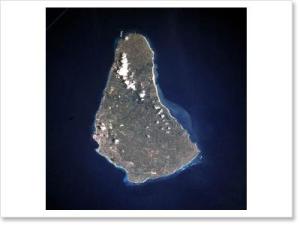
I’ve been thinking about the upcoming Copenhagen United Nations climate change conference—the opportunity to secure agreements to reduce global greenhouse gas emissions that will replace the Kyoto Protocol before it expires—because this year I’ve been living on a tiny coral island in the Atlantic Ocean. Here in Barbados, everywhere I look with my geologist’s gaze I see evidence of past climate change. And in the daily newspapers I read reports that record the nation’s worries about the effects of climate change on islander’s livelihoods. As is true for other small island nations, the future of all living beings on Barbados depends on productive conversations in Copenhagen.
Barbados is a coral island that rose roughly 1200 feet above sea level in the last one million years—in other words, Barbados is a geological infant. Still, it has much to teach us. I’m reminded of a verse from Pablo Neruda’s poem “Keeping Quiet”:
“If we were not so single-minded
about keeping our lives moving,
and for once could do nothing,
perhaps a huge silence
might interrupt this sadness
of never understanding ourselves
and of threatening ourselves with death.
Perhaps the earth can teach us
As when everything seems dead
And later proves to be alive.” *
Though some sandstone and shale form a nucleus of the island, more than 85% of the exposed land consists of coral rock, known to geologists as limestone, naturally lithified from broken debris of ancient coral reefs. The island is unique in the Caribbean. Unlike the Bahamas that consist largely of windblown sand cemented together by the action of rainwater, or other Caribbean islands so vividly volcanic, Barbados today is comprised of nothing more than subaerial coralline remnants of dead communities and submarine fringes of currently living colonies of organisms—corals. Tiny animals called polyps that are related to and look like sea anemones, each coral encloses itself in a stony cup of limestone that it secretes. As they grow, the polyps divide to form coral colonies that build up on top of each other and manifest as a reef. Over thousands of years, coral reefs respond to fluctuations in sea level as well as changes in water temperature and other environmental conditions.
Abiding on this island I traverse slopes telling me that where I now walk, ocean waves once lapped. Hillsides shaped like treads and risers of a coralline staircase, coastal terraces in geological parlance, mark ancient shorelines. These old coastal features some distance above the modern coastline indicate that with changing climate and consequent sea level fluctuations some colonial organisms have become extinct while others have succeeded them. As a Jewish Buddhist geologist—or jubugeoscientist as I’ve come to think of myself lately—I think of these ancient reefs as paleo-Sanghas, communities that lived and died together.
In thinking about Buddhist responses to climate change, I’ve come to believe that Buddhist scientists must emphasize compassion and the ethical conduct components of the eightfold path—wise speech, wise action, wise livelihood. Though we scientists lead with our heads, I believe that we must add our hearts to our enterprise. From my observations of impermanent coral communities, my head knows that the living communities of Barbados will be vulnerable to inevitable sea level fluctuations. But as I behold the Barbadian’s Earth, I realize that scientist-negotiators going to Copenhagen must bring to conversations more than scientific wisdom; they must bring scientific heart.
Just before I left for an extended silent meditation retreat with Sylvia Boorstein and Sharon Salzberg last week, I read that world leaders had concluded that it would be unrealistic to strive for a legally binding agreement at the upcoming climate conference. Instead, the Danes have suggested that some Copenhagen aspirations could be salvaged through a “first-stage series of commitments rather than an all-encompassing protocol.” I have an alternative suggestion for the U.N. climate conference organizers prompted by my recent sit with Sylvia and Sharon: let negotiators not speak; let them live together and practice karuna and metta meditation as a community of retreatants for the twelve days set aside for the conference. By the end of that period, perhaps negotiator-retreatants will feel connected enough to one another and the home countries they each represent so that true giving will be possible. In preparation for the retreat I’d be happy to send them a piece of Barbados limestone for the altar.
* Italics mine
Jill S. Schneiderman is Professor of Earth Science at Vassar College. This year she received a Contemplative Practice Fellowship from the Center for Contemplative Mind in Society. She is editor of and contributor to For the Rock Record: Geologists on Intelligent Design (University of California Press, 2009) and The Earth Around Us: Maintaining a Livable Planet (Westview Press, 2003).
For more about Buddhism and Green Living, visit our special page on the topic here on ShambhalaSun.com.
This Date in the Earth Year November 10, 2009
Posted by Jill S. Schneiderman in geologic time.add a comment
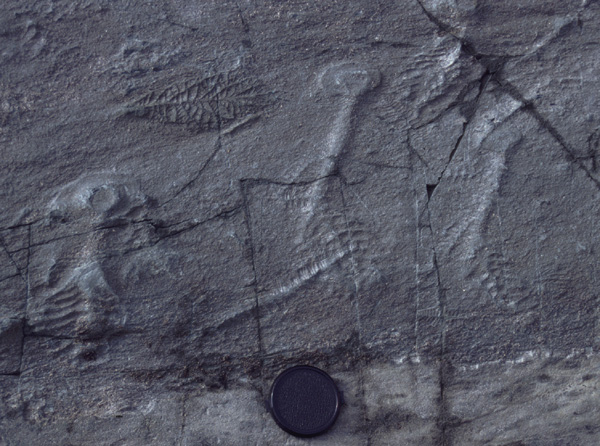
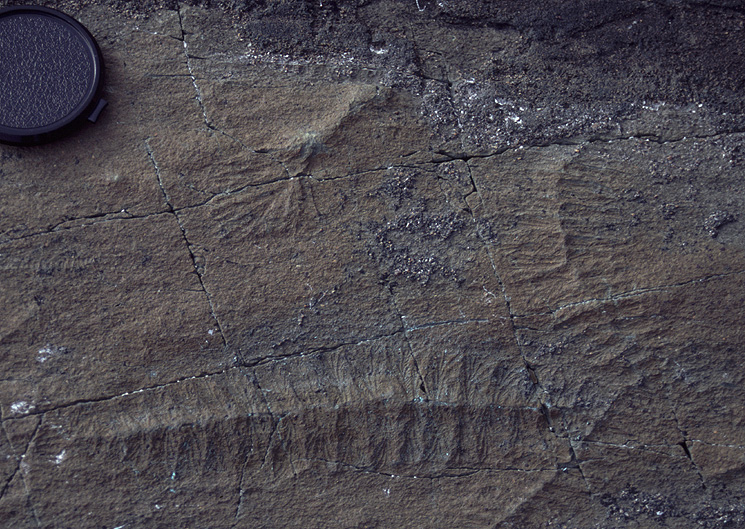
Today is day 314 out of 365 days in this (non-leap) year. In geologic time, November 10 represents approximately 629 million years ago. That puts us in the Vendian, the latest portion of the Proterozoic eon. What’s significant about the Vendian? Some rocks of this age, known most famously from the Ediacara Hills north of Adelaide, Australia, contain the earliest clear fossil evidence of multicellular animals; they indicate that these organisms, for the first time in earth history, have become a significant life form.
Spindle-shaped, long and pointed at both ends; branching, tree-like or network-like structures; large, round, disc shapes; lumpy cabbage-like figures; and, frond-like leafy forms—some with stalks; these fossils are the remains of soft-bodied organisms that lived in the sea and whose likeness to younger life remains obscure. Furthermore, geoscientists understand poorly their modes of life and their evolutionary relationships. Because they are typically large and flat with lots of external surface area, and therefore looking radically different from any known living animal, some paleontologists have assigned them to a completely separate kingdom of multicellular life!
Rocks along the White Sea coast of Russia and at Mistaken Point, a craggy, wind-swept promontory on the southern coast of the Avalon Peninsula in Newfoundland, also contain this type of ‘Ediacaran’ fauna. The idea that these fossils may represent another way of making a living, biologically speaking, —carrying out their bodily processes through one large external membrane— has inspired healthy scientific controversy.
This Date in the Earth Year October 11, 2009
Posted by Jill S. Schneiderman in geologic time.add a comment
As indicated in an earlier post (September 14), using a calendar year as a metaphor for the 4500 million years of Earth history and employing January 1, New Year’s Day, as the Earth’s birthday, I calculate the current date’s location in the Earth Year and detail what was happening paleontologically at that moment in Earth history.
Today, is day 284 out of 365 days in this (non-leap) year. Not even an entire month has elapsed since my last post on this subject, yet in geologic time, October 11 represents 999 million years ago. Though we are still in the Proterozoic eon, at this point in earth history single-celled organisms have begun to live together in colonies. Protozoans living in colonies would have occupied more space than protozoans living alone and might have been less vulnerable to challenges of daily living in the late middle Proterozoic. Furthermore, colonial living would have enabled some cells to specialize in certain tasks such as reproduction or locomotion. As a result, colonial protozoans might have had a metaphorical ‘leg-up’ in the late middle Proterozoic over their relatives who lived alone!
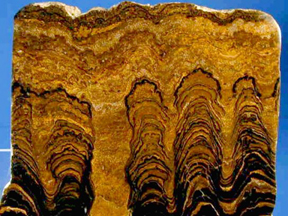
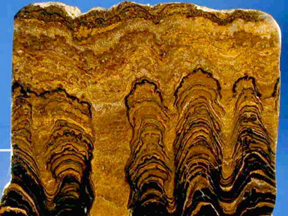
Evidence of these ancient colonial protozoans occur as fossilized stromatolites (pictured above). Found in numerous places on earth today, stromatolites are the main sedimentary features of carbonate rocks from earliest Earth history. They are the products of sediment trapping by mat-building microorganisms, known most widely as cyanobacteria. Living stromatolites also occur today but are quite rare because they are subject to predation.
Recycling Coal Ash October 6, 2009
Posted by Jill S. Schneiderman in coal ash, recycling.2 comments
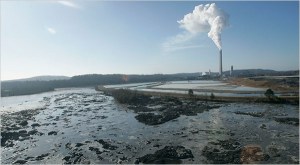
Albeit indirectly, Lesley Stahl’s segment of 60 Minutes (4 October 2009), reposted by CommonDreams.org raises two issues that, in my opinion, are very important. The first point is that recycling coal ash is not the panacea that the power industry would like it to be. I believe that the U.S. environmental movement has pushed the slogan “reduce, reuse, recycle” to such an extent that many people believe that most things we use can be recycled. This is not so and coal ash is an example of why everything we use can not be reused or recycled.
There are two great metaphors for the way we think about time: arrows, or time with direction; and cycles, time that endlessly repeats itself. When these two metaphors are combined, we have a realistic way to think about time–cyclic repetition with a difference. The 60 Minute piece brings to my mind the need to focus not preferentially on the cycles of time (and change) but the direction of changes as well. If we do this, we might have a positive and enduring approach to environmental change.
The second point passes in the moment when Lisa Jackson, Administrator of the U.S. EPA, states that she has no data that indicate the safety of certain products made with coal ash (e.g. school room carpeting). The good news embedded in Jackson’s statement is that the Precautionary Principle appears to be Jackson’s point of departure. This is a major change from the way that U.S. society has approached environmental risk in the past, when proof of harm falling on the shoulders of victims was the starting point for changed environmental regulations. Her statement indicates that the Obama Administration is shifting instead to proof of safety being borne by those who advocate “beneficial reuse” of purportedly innocuous substances before they are ‘repurposed’.
Copenhagen Climate Conference: Cyclic Repetition with a Difference? October 2, 2009
Posted by Jill S. Schneiderman in climate change, geologic time.3 comments
As Stephen Jay Gould wrote in Time’s Arrow, Time’s Cycle: Myth and Metaphor in the Discovery of Geological Time (Harvard, 1987), “If moments have no distinction, then they have no interest” (80). Gould proposed this aphorism as a description of the troubled situation that pure visions of time’s cycle impose upon history.
This passage holds significance for me as the world anticipates the upcoming United Nations climate change conference to be held in Copenhagen this December. Recently in Barbados’ daily newspaper, The Nation, a special two-page section drew readers’ attention to the country’s celebration of World Maritime Day (sponsored by the International Maritime Organization of which Barbados has been a member since 1970). The newspaper reported that the purpose of the day is to focus attention on the importance of the shipping industry, safety, and security, and the marine environment (24 September 2009, 20). The designated theme for World Maritime Day 2009 is climate change.
As an island nation with a heavily developed seashore and nearshore populated by locals as well as visitors, Barbados will face substantial challenges as sea level rises dramatically. Coral bleaching and depletion of seafood here also been linked to climate change. Furthermore, as a water scarce country, climate change also threatens drinking water supply of Bajans and their visitors.
So I’m struck by the overlap of the upcoming UN Conference, the focus of World Maritime Day and the precarious future portended by unattended climate change. It has me thinking about the cycles and arrows of time. Gould wrote about the model of a large disk rolling along a railroad track as a metaphor for intertwined arrows and cycles of time (81). Gould points out that cycles advancing as they turn allow for history. As his proposed aphorism states, moments without distinction have no interest. Without a way to distinguish between a particular stage in the cycle, we are unanchored in time. Everything comes round again, as Gould says (80).
For time to be truly meaningful, it must be more than cyclic repetition. But “cyclic repetition with a difference” as Gould refers to it combines time’s cycle with time’s arrow. Among the speechifying that may occur at Copenhagen, I would anticipate declarations of “now is the time,” exhortations to take action to curb greenhouse gas emissions immediately. It’s likely that speakers will extol the virtue of quick action because of our previous inattentiveness to increased greenhouse gas emissions and consequent global warming. Clearly time plays a significant part in this global conversation. The idea that there is urgency to the climate change talks, means the subject is climate change through time, not simply climate change in space.
My mind runs to the 1997 Kyoto Conference on Climate Change. How did the verbiage of that meeting go? Will verbiage at the Copenhagen conference sound the same as Kyoto? If so we will have nothing more than cyclic repetition or in Gould’s words, time’s cycle without time’s arrow.
Are we trapped in the view of climate change constrained by a dominant view of the Earth system as a system of endlessly renewing cycles? Carbon cycle, hydrologic cycle, nitrogen cycle, rock cycle, plate tectonic cycle. Reduce, Reuse, Recycle? With such an emphasis on reusing and recycling, maybe we may have lost sight of time’s arrow– the role that distinctive events play in making history.
Many factors indicate that we are not at the same place in the decision cycle pre-Copenhagen as we were pre-Kyoto. Global temperature is warmer, weather more disrupted, sea level higher. We should behave at Copenhagen in a way consistent with this reality. With such a consciousness, we can act on the arrow as well as the cycles of time as they relate to climate change.
Contemplating Sabbatical September 28, 2009
Posted by Jill S. Schneiderman in contemplative practice, sabbatical.3 comments

To every thing there is a season, and a time to every purpose under the heaven:
A time to be born, and a time to die; a time to plant; and a time to pluck up that which is planted;
A time to kill, and a time to heal; a time to break down, and a time to build up;
A time to weep, and a time to laugh; a time to mourn, and a time to dance;
A time to cast away stones, and a time to gather stones together; a time to embrace, and a time to refrain from embracing;
A time to get, and a time to lose; a time to keep, and a time to cast away;
A time to rend, and a time to sew; a time to keep silence and a time to speak;
A time to love, and a time to hate; a time of war, and a time of peace.
–Ecclesiastes 3: 1-8.
It feels, and indeed is impossible to write down these words without singing the words to the Byrds’ tune “Turn, Turn, Turn.” In fact, I had to put down my pen and sing them. They feel rejoiceful, to turn my own phrase.
I remember the first time that I learned that the words for the song came from the bible, Ecclesiastes in particular. I was sitting in Steve Gould’s History of Earth class, listening to him lecture about time’s arrow and time’s cycle, linear and cyclical time, the subject of the book on which he was working at the time. It opened my mind to the possibility of finding wisdom in the Bible. It was a startling recognition for me because up until that point I thought of religion as a source of oppression, mostly.
I guess there is some poetry to the fact that I am now rereading Gould’s relatively uncelebrated Time’s Arrow, Time’s Cycle: Myth and Metaphor in the Discovery of Geological Time (Harvard University Press, 1987). This book above all others has been my academic bible since I first encountered Steve twenty-five years ago as a graduate student. His consideration of deep time along with other fundamentals of geology, such as the igneous nature of granite, has fueled my teaching and thinking over the past quarter century.
Sabbatical years run from one Rosh Ha-Shanah to the next. And here I sit, erev Rosh Ha-Shanah, the biblical beginning of my sabbatical year, thinking about time and shmita (the biblical sabbatical year), Jubilee year and meditation. How am I to use this time? Though I haven’t consulted it recently, my institution’s faculty governance is probably spare in describing the purpose of sabbatical leave. And this is not my first, not my second, nor merely my third sabbatical, so one might wonder, why do I wonder about it? In fact, I’ve been thinking about this sabbatical as my Jubilee year sabbatical. As scholars more qualified to speak on this matter than I have pointed out, sabbatical has a biblical origin rooted in rest and spiritual regeneration.
According to Genesis, God created the earth and all its life in six days, and on the seventh day God rested, hence the seventh day as a Sabbath, a day of rest. Additionally, other books of the old Testament describe the sabbatical year, the seventh year of the seven-year agricultural cycle mandated by the Torah for the Land of Israel, in which tillers of the earth let the ground lie fallow, debts are forgiven, slaves are freed. I wonder how many of my academic colleagues recognize the biblical origin of sabbaticals every seventh semester or every seventh year (for those of us fortunate enough to be faculty at institutions that offer them). I’ve questioned a few of my colleagues about this and it has escaped the attention of most whom I’ve asked. Of course, I’m faculty at a religiously unaffiliated institution. Perhaps it’s different at Jesuit and other religious institutions of higher education.
For me, this sabbatical year has special significance. I’ve not had seven sabbaticals but this year I am fifty years old. According to the Bible, the sabbatical year was originally part of a 50-year cycle of which the climax was the Jubilee year when all land was returned to its ancestral owners and Hebrew slaves who had chosen to remain in service after the biblical six-year maximum were released. It feels right to me to plan to spend this special sabbatical year resting, and being, and contemplating time.
A Contemplative Practice Fellowship from the Center for Contemplative Mind in Society enables me to undertake this project, if one should even call it that, because the fellowship validates the endeavor. I’m reading about time; returning to the season of my earliest intellectual coming of age; considering directional time and cycling time; trying to understand how different cultures, and religious/spiritual traditions have lived with it; hoping to find a way to develop a course on the subject as I promised the Center; and looking for ways to address with my colleagues the problem that University of Washington, information technology professor David Levy refers to as “no time to think.”
There’s irony in making something of a sabbatical. The Googling I’ve done to see what others have written about the origins of academic sabbaticals leads me to a paucity of papers—a bit of history, a bit more about harnessing employees’ potential and utility for an institution or business. Most everything I read moves quickly beyond what seems to me to be the essence of sabbatical: renewal of spirit and intellect as they seek meaning and value in life.
I sit and gaze at the orange and green photograph of a robed Thai monk looking pensively across a small, still lily pond. A photographer friend and colleague gave me the photo more than a decade ago and it has traveled with me from the west coast of the U.S. to east, from house to dorm faculty apartment to house as if accompanying me because it would one day be significant beyond its attractive color and composition. It’s my purpose to sit, to be still, during my Jubilee sabbatical, and see what arises. I’m bolstered by having removed myself from the United States to accompany my spouse on her Fulbright to the University of the West Indies in Barbados, the country in the western hemisphere with the oldest known synagogue founded in 1654 by Sephardic Jews fleeing persecution in Brazil. Physically away from demands of colleagues and expectations of students, I’m facilitating this opportunity to let the terrain of my mind lie fallow, to meditate to see what arises. This is the convergence of my contemplative practice fellowship and my sabbatical year. So to all my colleagues beginning sabbatical l’shana tova, let the sweet new year begin.
—
This Date in the Earth Year September 14, 2009
Posted by Jill S. Schneiderman in geologic time.add a comment
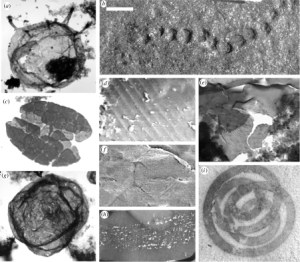 Proterozoic life (Image used by permission of A.H. Knoll)
Earth formed approximately 4.5 billion years ago (bya) also known as 4500 million years ago. It’s difficult, maybe even impossible to get a good sense of this length of time. Yet we must “feel deep time in our guts” as my late-mentor Steve Gould referred to the endeavor, if we are to live harmoniously on the planet. Today I write the first of an occasional series, “This Date in the Earth Year,” in an effort to help the layperson develop a feel for geologic (deep) time.
Using a calendar year as a metaphor for the 4500 million years of Earth history and employing January 1, New Year’s Day, as the Earth’s birthday, I calculate the current date’s location in the Earth Year and detail what was happening paleontologically at that moment in Earth history. For example today, September 14, is day 257 out of 365 days in this (non-leap) year. With so much of a calendar year having elapsed, one might think that at this point in the Earth Year, some pretty complex organisms might have been roaming the planet. Not so.
In geologic time, September 14 represents 1330 million years ago, the Proterozoic —the second of two eons that comprise the immense stretch of time called the Precambrian. Many of the most important events in earth history took place during the Precambrian including the formation of life, the accretion of the earth’s first tectonic plates, the proliferation of oxygen in the atmosphere, and the evolution of eukaryotic cells (single-celled organisms with internal organization). Still, at 1330 million years—the middle Proterozoic—the only living things on Earth were ocean-dwelling single-celled organisms.
On Contemplative Times August 15, 2009
Posted by Jill S. Schneiderman in contemplative practice, earth cycles, hydrologic cycle.7 comments
 A recent New York Times Op-Ed (August 14, 2009) contained the piece “Thirsting for Fountains.” According to the editors, they asked eight illustrators to observe for one hour the activity at a local water fountain. Their rationale: “If drinking fountains were as ubiquitous as fire hydrants, there would be no need for steel thermoses, plastic bottles or backpack canteens. Thirsty folks could just amble over to the next corner for a sip of free-of-charge, ecofriendly, delicious water.”
I’m fresh off a week-long retreat on contemplative pedagogy sponsored by the Center for Contemplative Mind in Society so I am able to see clearly that the NYT editors challenged these illustrators with a contemplative exercise. Sit and behold. From what I can tell, the illustrators played to their strengths. All drew the fountain where they observed passersby. They made other observations: temperature and taste of the water; number, age, gender identity, garb, even species, of consumer. With words also, each painted a picture of activity at the fountain. What emerged was a cross-sectional slice of life. And the idea that a more harmonious and just means for human interaction with the hydrologic cycle as we attempt to procure drinking water is the fair and fluid one of fountains not bottles. Simple truth from a simple exercise.
Sustaining Contradictions August 11, 2009
Posted by Jill S. Schneiderman in contemplative practice, earth cycles, geology, mountain building.add a comment
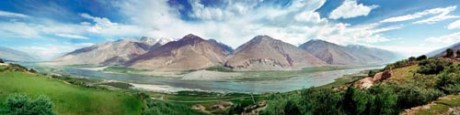
Yesterday I listened to Arthur Zajonc speak about the importance of sustaining contradiction in order to cultivate a deep epistemology of mind. Zajonc, professor of physics at Amherst College and scientific coordinator for the Mind and Life dialogue with H.H. the Dalai Lama, pointed out to our faculty group who had gathered for a contemplative pedagogy conference, that we must be able to sustain contradictions for ourselves and our students if we are to have a fresh experience of an object or a phenomenon. Physicists, he said, live with the wave-particle duality while mathematicians embrace the point at infinity.
Here I add to his list of sustained contradictions in the sciences a contribution from my own discipline, geology. As Arthur spoke, I saw the peaks of the Karakoram range in Northern Pakistan, a rugged landscape near Nanga Parbat that I helped map in 1990. This dynamic region at the confluence of the Pamir, Karakoram, Hindu Kush and Himalyan ranges—known as the roof of the world—is both rising up and wearing down simultaneously. Geologists study this spectacular orogen, created by the collision between the Asian and Indian lithospheric plates beginning 60 millions years ago, in order to examine questions such as how does continental lithosphere form? How are continents assembled? How are they reworked and deformed? Breathing laboriously at the highest altitudes on earth while stepping gingerly over unstable talus slopes, geologists doing the field work physically sustain contradictions.
‘Two-minute lecture’ on Deep Time August 6, 2009
Posted by Jill S. Schneiderman in geologic time.add a comment
 rs understand how brief has been human tenure on planet Earth.
 earthdharma.org