Geological Reserves in Afghanistan February 2, 2010
Posted by Jill S. Schneiderman in Afghanistan, mineral resources.1 comment so far
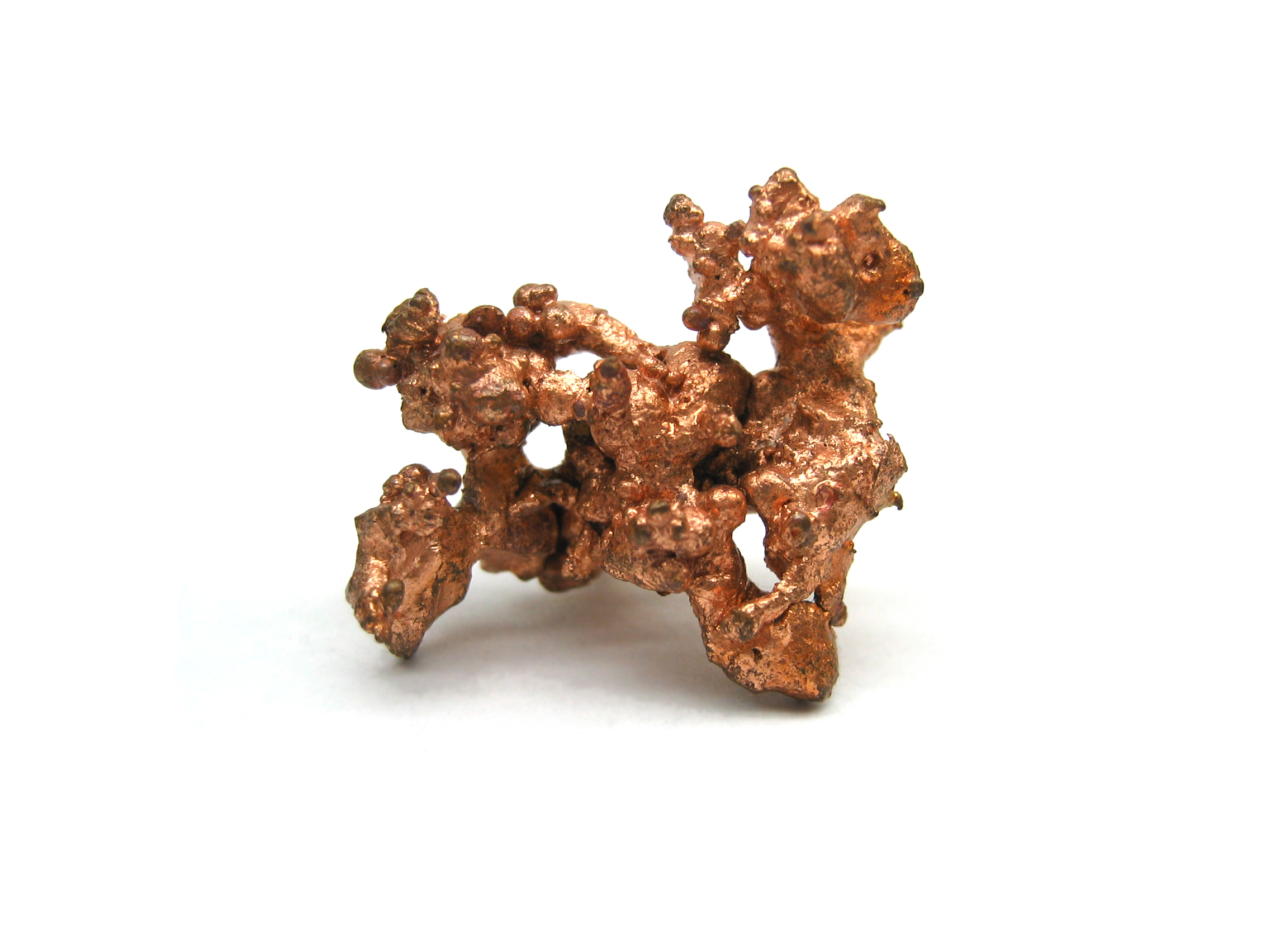
Did you know that the U.S. Geological Survey is working in Afghanistan? According to the USGS, the program in natural resources and hazards assessment for Afghanistan is part of the “Afghanistan Reconstruction Program.” The initial activities include coal, mineral and water resources assessments and earthquake hazard assessment as well as geospatial infrastructure development and institution capacity building. (USGS Projects in Afghanistan).
President Hamid Karzai recently pointed out that the forthcoming results of the USGS resource survey of the country will show that the value of geological materials in Afghanistan ranks in the trillions of dollars (Afghan ‘Geological Reserves Worth a Trillion Dollars.’) Though not renowned as a resource-rich country, significant amounts of copper, iron ore, gold, and chromite, as well as natural gas, oil, and precious and semi-precious stones occur in the country.
Edwidge Danticat on Haiti Earthquake Devastation January 29, 2010
Posted by Jill S. Schneiderman in Buddhist concepts, Haiti.add a comment
 In Brother, I’m Dying, writer Edwidge Danticat retold the heartbreaking story of her Uncle Joseph’s detention and death, and his son Maxo’s attempt to save him. Danticat has a piece in the Comment section of this week’s New Yorker, “A Little While,” in which she pays tribute to her cousin Maxo who died after being crushed beneath a building that fell during the Port-au-Prince earthquake.
In my first post after the Haitian earthquake, I asked the question “Why not me?” in regard to the issue of abrupt change. Her moving words in The New Yorker reflection speak volumes about about kindness, chance, and impermanence:
The day that Maxo’s remains were found, the call came with some degree of excitement. At least he would not rest permanently in the rubble. At least he would not go into a mass grave. Somehow, though, I sense that he would not have minded. Everyone is being robbed of rituals, he might have said, why not me?
By the time Maxo’s body was uncovered, cell phones were finally working again, bringing a flurry of desperate voices. One cousin had an open gash in her head that was still bleeding. Another had a broken back and had gone to three field hospitals trying to get it X-rayed. Another was sleeping outside her house and was terribly thirsty. One child had been so traumatized that she lost her voice. An in-law had no blood-pressure medicine. Most had not eaten for days. There were friends and family members whose entire towns had been destroyed, and dozens from whom we have had no word at all.
Everyone sounded eerily calm on the phone. No one was screaming. No one was crying. No one said “Why me?” or “We’re cursed.” Even as the aftershocks kept coming, they’d say, “The ground is shaking again,” as though this had become a normal occurrence. They inquired about family members outside Haiti: an elderly relative, a baby, my one-year-old daughter.
I cried and apologized. “I’m sorry I can’t be with you,” I said. “If not for the baby—”
My nearly six-foot-tall twenty-two-year-old cousin—the beauty queen we nicknamed Naomi Campbell—who says that she is hungry and has been sleeping in bushes with dead bodies nearby, stops me.
“Don’t cry,” she says. “That’s life.”
“No, it’s not life,” I say. “Or it should not be.”
“It is,” she insists. “That’s what it is. And life, like death, lasts only yon ti moman.” Only a little while.
Caribbean Awakening January 28, 2010
Posted by Jill S. Schneiderman in Barbados, Buddhist concepts, disasters, earthquakes, Haiti.add a comment
This piece is cross-posted at Shambhala SunSpace.
 Jack Kornfield has commented that Suzuki Roshi captured the essence of Buddhism with the words: “not always so.”
Reports of earthquakes and tsunamis in the Caribbean region continue to shake my world in Barbados and remind me of Suzuki Roshi’s wisdom.
A 6.0 earthquake sixty miles southwest of Guatemala City shook the Guatemalan countryside and parts of El Salvador on January 18. The next day, one week after the Port-au-Prince earthquake, a 5.8 magnitude earthquake rattled the Cayman Islands. And though it was underreported, the devastating Port-au-Prince earthquake did in fact trigger a localized tsunami. It swept at least seven people to sea and drowned portions of the Haitian coastline in the village of Petit Paradis, located on the south side of the Enriquillo-Plantain Garden fault system that ruptured to produce the January 12 magnitude 7.0 temblor. (More on this here. )
As a geologist my mind knows that the Caribbean is a tectonically active region that poses volcanic, seismic and tsunami hazards. The hazards result from the subduction of the American Plate beneath the much smaller Caribbean Plate; it generates the overlying chain of volcanic islands as well as lithospheric crustal movement along the subducting plate boundary and in the region of intense folding at the plate margin.
 Tectonic map of the Lesser Antilles showing plate boundaries, rates of plate movement, active volcanoes, major faults and regions of strong deformation (from Day et al. 2008, Issues in Risk Science: Tectonic Threats in the Caribbean; http://www.abuhrc.org/rp/publications/Pages/issues.aspx)
But aside from the volcanic activity ongoing at Soufrière Hills, Montserrat since 1995 and eruptions in 1979 from Soufrière in St. Vincent and in 1976 from La Soufrière in Guadeloupe—Soufrière means sulfur in French, hence the large number of volcanoes that bear the name — the area has been relatively quiet, volcanically speaking. And though earthquakes have caused the second and third most destructive geological disasters in the Caribbean as a whole, they occurred in 1692 — an earthquake and tsunami destroyed Port Royal in Jamaica and more than half the inhabitants died in the event itself or later of disease — and 1843 when an earthquake severely damaged Guadeloupe and nearby islands. Relatively minor earthquakes in 1761, 1823, and 1918 caused tsunamis on various islands but none resulted in devastating disaster and death. So, when I read reports warning that the “long-sleeping Caribbean” has awakened — that the ruinous quake that struck Haiti could be the first of several in the region — I experience cognitive dissonance.
I’ve come to the eastern Caribbean with my partner and our two children on a family sabbatical of sorts so that we might rest, rejuvenate, and live with ease. While so engaged the earth stirred and reminded me that, in the words of Kalu Rinpoche:
Nothing is permanent:
The sun and the moon rise and then set,
The bright, clear day is followed by the deep, dark night.
From hour to hour, everything changes.
But I’ll also take the advice uttered by Jean Frank, a Haitian fisherman in Petit Paradis making a fishing net in the shade away from the heat. Having already lived a long life, the fisherman said in Creole “Me? I’m not afraid. I’m old … I take life as it comes.”
For more “Earth Dharma” from Jill S. Schneiderman, click here.


Trackbacks are closed, but you can post a comment.
After Haiti — Remixing the Mind & Heart January 20, 2010
Posted by Jill S. Schneiderman in Buddhist concepts, disasters, earthquakes, geology, Haiti.add a comment
This piece is cross-posted at Shambhala SunSpace.

Recent reports from different media on the Haitian earthquake illustrate the human proclivity to separate mind and heart in response to so-called ‘natural’ disasters.
In two U.S. Geological Survey (USGS) CoreCast 10-minute audio programs, using accessible language, Michael Blanpied, USGS Earthquake Hazards Program Coordinator, discusses the January 12, 2010 Haitian earthquake. In “Magnitude 7.0 Earthquake Strikes Haiti” (episode 117), Blanpied explains the science of the earthquake and related hazards, such as landslides. In “The Haitian Earthquake-A Week Later” (episode 118), Blanpied provides an update on the current situation in Haiti and answers questions about aftershocks. Additionally, perhaps as a means to assuage fears with knowledge, an article in the Christian Science Monitor explains clearly the January 20, 6.1 magnitude aftershock (Haiti Aftershock).
Note that in the USGS CoreCast programs, Blandpied comments not at all about the suffering and human dimension of the earthquake. Therefore, because I believe that technical science talk alone will not sufficiently address the current situation, I was glad to hear host Tania Larson “Magnitude 7.0 Earthquake Strikes Haiti” (episode 117) express compassion for those who are suffering as a result of the earthquake. Blanpied’s talks are wise-minded. Larson’s concluding comments are kind-hearted.
But what will be most helpful in this and future disasters will be a remix of mind and heart that I’d like to characterize as kind-minded and wise-hearted responses. An E-Bulletin (No. 47, January 2010) from the International Union of Geological Sciences (IUGS), whose motto is “Earth Science for the Global Community” illustrates such a blend of heart and head. Since it is not yet available on the IUGS website I quote it here:
TRAGIC EARTHQUAKE HITS HAITIAs we were going to press with this latest IUGS e-Bulletin, a magnitude 7.0 earthquake struck Haiti, near the city of Port-au-Prince on 12 January 2010 causing immeasurable loss of life and damage to critical infrastructure. As we usher in the year 2010, we are humbly reminded that many tragedies around the world often relate to the dynamic nature of planet Earth. As Earth Scientists, we all well appreciate the need to better understand the causes of natural hazards. It is terrible and unfortunate that events such as earthquakes, tsunamis, landslides and volcanic eruptions continue to impact such significant numbers of people around the world. Our collective efforts through geoscience education, practical field research and innovative studies can help to minimize the risks of natural hazards, reduce human vulnerability and enhance the safety of the global society. On behalf of the many geoscientists represented by the IUGS, we send our heartfelt condolences and sympathies to the many people affected by this recent catastrophe.
For more “Earth Dharma” from Jill S. Schneiderman, click here.
Trackbacks are closed, but you can post a comment.
Mountaintop Coal Removal January 18, 2010
Posted by Jill S. Schneiderman in coal mining.add a comment
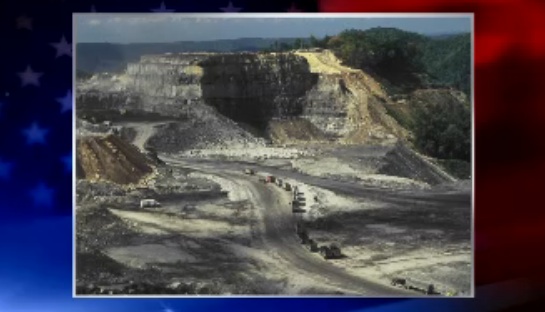 Watch geoscientist Margaret Palmer discuss mountaintop removal as a mode of coal mining.
Haiti’s Earthquake—Why Not Me? January 13, 2010
Posted by Jill S. Schneiderman in Buddhist concepts, earthquakes, Haiti.add a comment
This is cross-posted at Shambhala SunSpace.

“Awareness of impermanence is encouraged, so that when it is coupled with our appreciation of the enormous potential of our human existence, it will give us a sense of urgency that I must use every precious moment.“–The 14th Dalai Lama.
I awoke this morning from my peaceful perch in Barbados to news of a massive earthquake yesterday in Haiti on the island of Hispaniola. In the BBC report that alerted me to the event, a British Geological Survey geologist commented that the 7.0 quake, centered ten miles west of Port-au-Prince, hit a bad trifecta: large magnitude, poor country, dense population.
But that’s not really so remarkable; one need only think back to the 1988 Armenia; 1999 Izmit, Turkey; 2005 Kashmir, Pakistan; or 2009 Sichuan, China earthquakes to know that accumulated stress in the earth always finds release in geologic, if not human, time. But for those who pay attention to these types of “natural” disasters, what was more startling was the location of this earthquake.
Pakistan, Turkey, Georgia, Afghanistan, Iran, India, China. This litany of earthquake foci may unsettle but not surprise us because we know that these locations trace the arcs of great mountain ranges at the suture zones between colliding continents. Expected Caribbean “natural” disasters, on the other hand, usually center on volcanic eruptions, hurricanes, and landslides. Indeed, Haiti has not experienced an earthquake of this magnitude since 1770. But in a corollary to the caution that “where there is smoke, there is fire,” to the geological savant, where there is volcanism there are earthquakes. And indeed, the collision of the Caribbean Sea and North American lithospheric plates is the agent of both these Caribbean phenomena.
Barbados, in the easternmost Caribbean, is a coral platform rather than an active volcanic center. Still, I wondered if I had felt the shaking. Depending on magnitude, lithospheric ruptures anywhere in this region could be perceived by others islanders because, to seismic energy, the Caribbean is a small place. We know that Haitians felt it horribly. And according to the BBC, their spontaneous responses have included prayer. Such responses connect Haitians to other people who have endured this kind of trauma. Like the Great Lisbon earthquake of 1755 that inspired debate among common people as well as luminaries including Voltaire, Alexander Pope, Immanuel Kant, and Jean-Jacques Rousseau on the subject of God’s place in the natural world and human affairs, along with concerted efforts at disaster control, the Haiti earthquake spurs entreaties for intercession and appeals for compassion.
The earthquake caused me to recall Buddhist teacher Sylvia Boorstein’s response to the question “Why me?” spoken when extraordinary lamentable conditions arise. “Why not me?” teaches Boorstein. The earthquake in Haiti reminds me that the Earth is home to myriad creatures who are but temporary global residents; at every moment, all living beings are the Earth’s subjects. Yet social and economic circumstances cause some living beings greater vulnerability to such disasters. I’m glad that, according to my children, in Barbados study of “natural” disasters is part of the social, not natural, science curriculum. It underscores that indeed these phenomena are both social and “natural” and that our responses must include compassion, kindness and prayer as well as scientific questions and explanations.
For more “Earth Dharma” from Jill S. Schneiderman, click here.
Trackbacks are closed, but you can post a comment.
Ocean as Carbon Sink January 9, 2010
Posted by Jill S. Schneiderman in climate change, earth cycles, hydrologic cycle.add a comment
D an Laffoley, marine ecologist and a vice chairman of the World Commission on Protected Areas at the International Union for Conservation of Nature, had an important op-ed in the New York Times on December 26, 2009 regarding the importance of the world’s oceans as sinks for carbon dioxide.
Dr. Laffoley stated that despite the disappointments of the Copenhagen climate talks, an agreed upon program in which developing countries would be compensated for preserving peat soils, swamps, fields and forests that are efficient absorbers of carbon dioxide, is an economical and promising way to store large amounts of carbon. However he points out that the program is limited because it aims to protect only land-based carbon sinks. We should mind his injunction to seek out marine-based options for curbing climate change as well. Here’s a link to the full op-ed: “To Save the Planet, Save the Seas”.
Satellite View of a Densely Populated Small Island Nation December 16, 2009
Posted by Jill S. Schneiderman in Barbados, satellite images.add a comment
Satellite Image of Greater Bridgetown, Barbados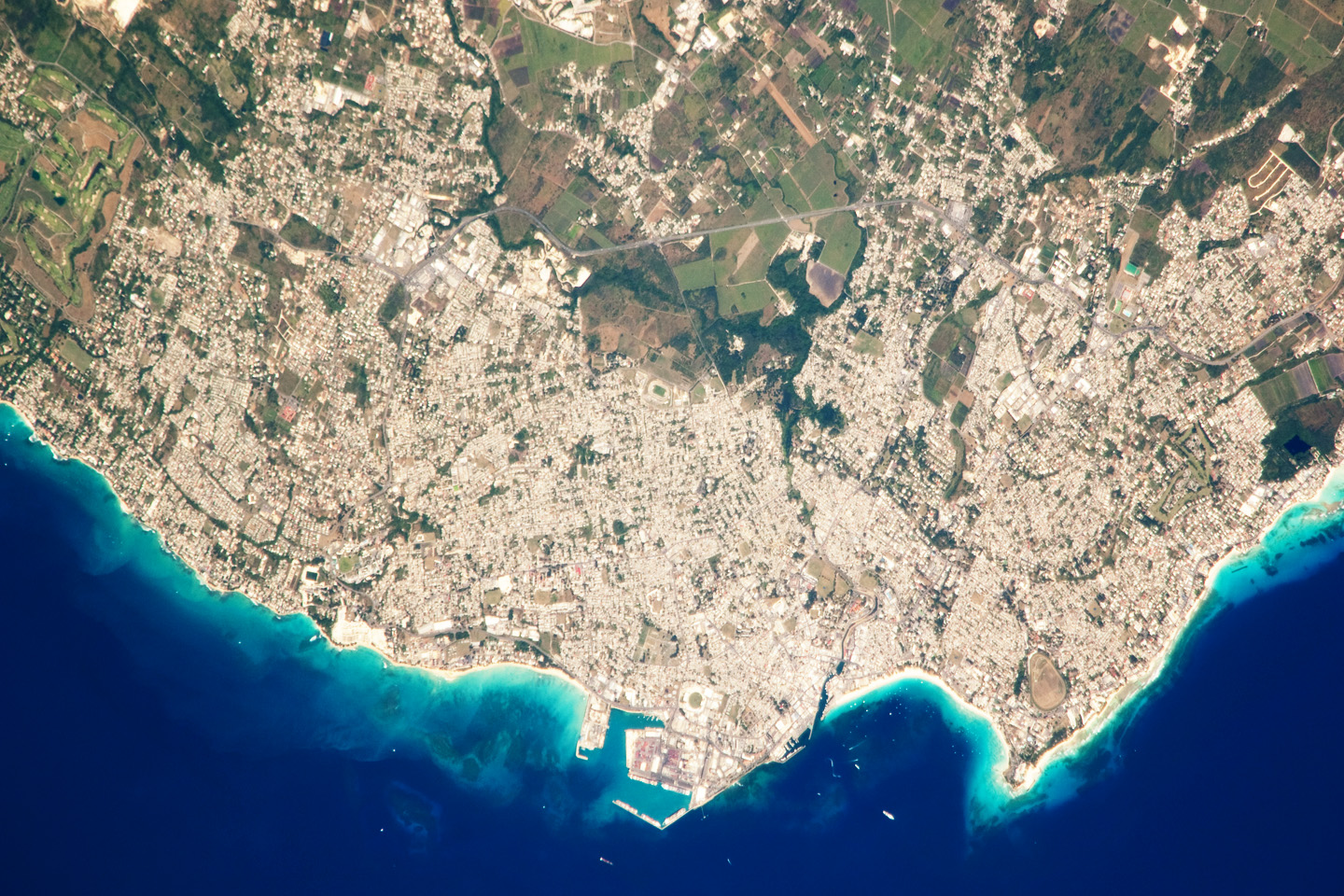
Click on link for full description of this image from NASA’s Earth Observatory.
‘Natural’ Disasters, Suffering, and Joy December 11, 2009
Posted by Jill S. Schneiderman in book review, Buddhist concepts, climate change, disasters, earth community, geology.1 comment so far
This is cross-posted at Shambhala SunSpace.

In an interview published about her recent book A Paradise Built in Hell: The Extraordinary Communities that Arise in Disaster (2009) in The Rumpus, a new online magazine focused on culture, Rebecca Solnit comments that “there are disasters that are entirely man-made, but none that are entirely natural.” In the book, Solnit examines five disasters and the behavior of regular people in the aftermath of the events: the 1906 San Francisco earthquake and fires, the Halifax munitions cargo ship explosion of 1917, the Mexico City earthquake of 1985, the events of 9/11 and Hurricane Katrina. Solnit’s interview comment caught my eye because as a self-proclaimed jubugeoscientist I recognize the truth of her important observation. I teach a course on Geohazards at Vassar College, so named to help students avoid the misperception that any modern-day disaster is completely ‘natural.’ The causes of so many of Earth’s disasters—not least among them climate-change augmented hurricanes—have roots in actions we humans undertake on the planet to satisfy our desires; the effects of our activities result in suffering among all living beings.
Even more remarkable to me than Solnit’s accurate observation about the agents of disasters is her assertion that while hurricanes, tsunamis, and earthquakes are not to be wished for, they are among disastrous events that elicit our best responses and provide common purpose. Solnit maintains that “fleeting, purposeful joy fills human beings in the face of disasters. Everyday concerns and societal strictures vanish. A strange kind of liberation fills the air. People rise to the occasion. Social alienation seems to vanish.” Solnit’s affirmation causes my Buddhist heart to swell with joy because I see that she has unearthed evidence of metta (lovingkindness) and karuna (compassion) in unlikely events and places. It seems to me that Solnit shows us that in these moments of crisis, human beings become awake.
To describe the responses of ordinary people during these episodes, Solnit uses phrases such as: spontaneous caring, rational generosity, courage under duress, brave altruism. They illustrate Solnit’s main point that in these circumstances people are mostly kind, generous, brave, resourceful and creative. Rather than seeing civilians acting during times of crisis as, at best, a merely frightened and disoriented mass of humanity and at worst, a dumb, thieving, murderous mob, Solnit reveals invigorated and capable citizens. Solnit writes:
“Disaster requires an ability to embrace contradiction in both the minds of those undergoing it and those trying to understand it from afar. In each disaster, there is suffering, there are psychic scars that will be felt most when the emergency is over, there are deaths and losses. Satisfactions, newborn social bonds, and liberations are often also profound. Of course one factor in the gap between the usual accounts of disaster and actual experience is that those accounts focus on the small percentage of people who are wounded, killed, orphaned, and otherwise devastated, often at the epicenter of the disaster, along with the officials involved. Surrounding them, often in the same city or even neighborhood, is a periphery of many more who are largely undamaged but profoundly disrupted — and it is the disruptive power of disaster that matters here, the ability of disasters to topple old orders and open new possibilities. This broader effect is what disaster does to society. In the moment of disaster, the old order no longer exists and people improvise rescues, shelters, and communities. Thereafter, a struggle takes place over whether the old order with all its shortcomings and injustices will be reimposed or a new one, perhaps more oppressive or perhaps more just and free, like the disaster utopia, will arise.”
Solnit’s message echoes the three jewels of Buddhism: Buddha, Dharma and Sangha. In the aftermath of disaster, people wake up to the reality that suffering is inevitable and also recognize that the way we respond to the suffering in our communities dictates whether that suffering will be alleviated or exacerbated.
An August 2009 New York Times book review calls A Paradise in Hell, an optimistic book and The Rumpus recommends that one read it with Solnit’s earlier work, Hope in the Dark: Untold Histories, Wild Possibilities because together these books reassure us that our actions are important even when we don’t see—or can’t recognize—results in our lifetimes. I’ll be reading these books during the Copenhagen climate change meetings in the hope that negotiators will be able to wake up before the next wave of disasters roll in from the rising seas.
Jill S. Schneiderman is Professor of Earth Science at Vassar College. This year she received a Contemplative Practice Fellowship from the Center for Contemplative Mind in Society. She is editor of and contributor to For the Rock Record: Geologists on Intelligent Design (University of California Press, 2009) and The Earth Around Us: Maintaining a Livable Planet (Westview Press, 2003).
For more about Buddhism and Green Living, visit our special page on the topic here on ShambhalaSun.com.
Trackbacks are closed, but you can post a comment.
Melting Glaciers December 10, 2009
Posted by Jill S. Schneiderman in climate change, geology, hydrologic cycle.add a comment
Though the New York Times chose not to publish it, I’m posting my letter to the editor regarding Thomas Friedman’s December 9, 2009 Op-Ed about ‘Climategate.’
To the editors,
In “The Odds of Disaster,” (12/9/09) Thomas Friedman writes, “…evidence that our planet has been on a broad warming trend has been documented….” With the brouhaha about hacked data from East Anglia’s Climatic Unit looming over Copenhagen, I recommend the online archive of glacier photographs from the National Snow and Ice Data Center (http://nsidc.org/data/glacier_photo/index.html).
The collection contains photographs taken from the same vantage, at the same season, but separated by decades. Witness:
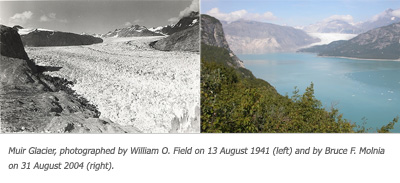


With regard to the Muir Glacier, according to U.S. Geological Survey scientists, the glacier retreated more than seven miles and thinned by 875 yards over a sixty year period.
One need not have a degree of any sort to see the melting. Whether or not anthropogenic greenhouse gases are the cause hardly matters; as the crysophere melts, meltwater expands, flows into oceans and sea level rises.
‘Climategate?’ I agree with Tom, “be serious.”
Jill S. Schneiderman
Professor of Earth Science, Vassar College
Poughkeepsie, NY
Image used by permission: NSIDC/WDC for Glaciology, Boulder, compiler. 2002, updated 2006. Glacier Photograph Collection.
Boulder, CO: National Snow and Ice Data Center/World Data Center for Glaciology. Digital media.
 earthdharma.org
